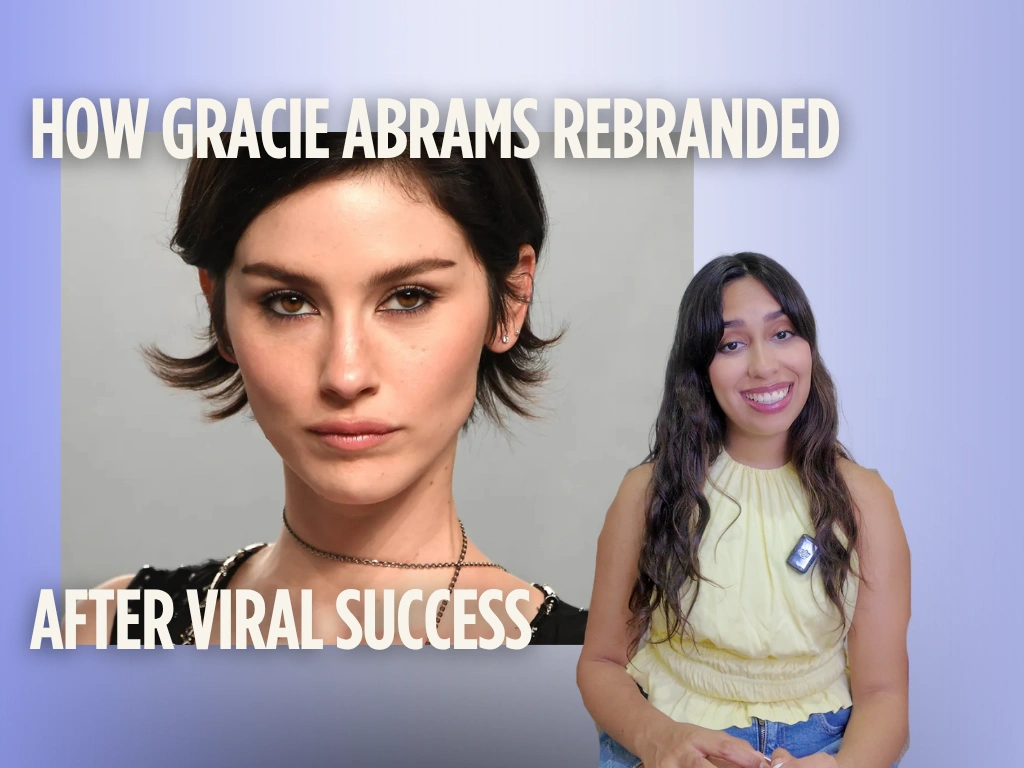
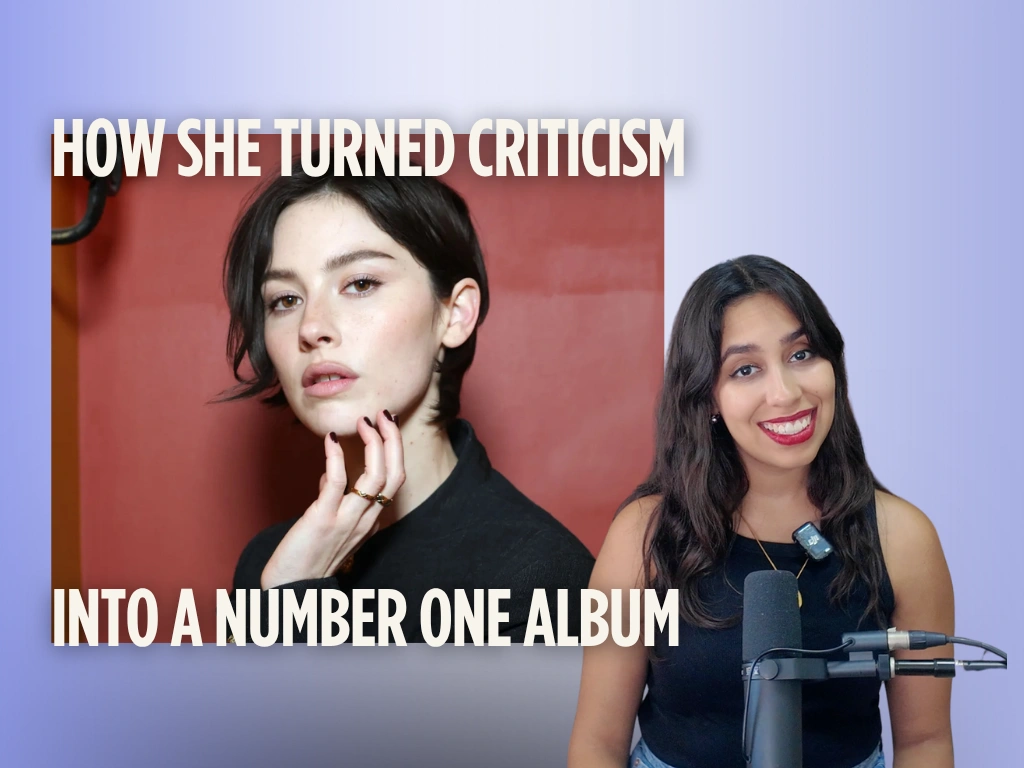
Gracie Abrams had every reason to make her next album bigger, shinier, and more commercially polished. After spending an entire year riding the wave of The Secret of Us, opening for Taylor Swift in front of millions of people, and becoming one of the biggest names in modern singer-songwriter pop, the obvious move would have been to simply make everything bigger. More production, bigger singles, more spectacle, more pop. Instead, Gracie Abrams did the opposite. Her team stripped away the gloss, leaned into the criticism surrounding her, built an intentionally cold visual identity, and turned her personal story into the centerpiece of the campaign.
On July 17, 2026, that strategy paid off with Daughter from Hell becoming Gracie Abrams’ first Number One album on the Billboard 200. But the most interesting part of the campaign isn’t the chart position. It’s how the rollout turned Gracie Abrams herself into the story. Rather than trying to escape conversations around her family background, her relationship to Taylor Swift, or criticism of her music, the campaign incorporated those tensions into the identity of the album.
For artists, managers, and labels, Daughter from Hell is a case study in how to transform an existing narrative into a marketing advantage. It shows what can happen when an artist stops trying to outrun the perception surrounding them and instead turns that perception into creative material.
Why “Daughter from Hell” Matters for Independent Artists
Daughter from Hell was not simply a standard album release. It was a strategic repositioning built around vulnerability, storytelling, cultural curiosity, and emotional investment. The campaign connected streaming infrastructure, outdoor advertising, short-form content, visual storytelling, strategic collaborations, fashion, and physical fandom into one larger narrative.
What makes that particularly interesting is that none of these tactics existed in isolation. The streaming strategy helped convert attention. The outdoor campaign gave fans something to discover in the physical world. The singles functioned as chapters of a larger story. The collaborators expanded the cultural meaning of the album, while the visual identity made the entire era recognizable.
That is the difference between promoting an album and building an era. The goal isn’t simply to get people to hear a song. It’s to create enough curiosity, emotion, and cultural relevance that people want to understand the artist behind it.
1. Stop Fighting Your Narrative: Gracie Turned Her “Problem” Into the Concept
The “Nepo Baby” Conversation Became Creative Material
Before Gracie Abrams could sell Daughter from Hell, she had to solve a bigger marketing problem: how people perceived Gracie Abrams herself. Every artist eventually develops what we can call a narrative tax. It is the story people already associate with you before they even hear your next song.
For Gracie, that narrative was complicated. She is the daughter of filmmaker J.J. Abrams, and the “nepo baby” conversation has followed her throughout her career. At the same time, after opening for Taylor Swift and becoming increasingly associated with Taylor’s audience and ecosystem, some people began reducing Gracie’s identity to being a softer or younger extension of something that already existed.
Then there was criticism of the music itself. Some critics saw her understated production and intimate songwriting as emotionally repetitive, too restrained, or overly melancholic. From a traditional marketing perspective, the solution might seem obvious: make the next album bigger. Change the sound, increase the spectacle, and distance the artist from the criticism.
Gracie’s team made a very different decision. They went anti-gloss. Instead of trying to make vulnerability disappear, they made vulnerability the foundation of the era. And that’s where the title Daughter from Hell becomes particularly important. The word “daughter” immediately connects to the family narrative that has followed Gracie throughout her career. But rather than allowing other people to define what that word means for her, she transformed it into part of her artistic identity.
The conversation suddenly becomes more interesting. It’s no longer simply, “She’s J.J. Abrams’ daughter.” It becomes: what does it actually mean to be someone’s daughter? What does that relationship look like from the inside? How does family shape identity, adolescence, vulnerability, and adulthood? That is a much more compelling story.
The Lesson: Own the Narrative Before Someone Else Does
Artists often spend enormous amounts of energy trying to correct how people perceive them. But sometimes the strongest strategy is not to reject the narrative. It’s to take ownership of it.
If people already associate you with a particular story, find a way to give that story a new meaning. A perceived weakness can become part of your visual identity. A criticism can become a creative theme. A personal history can become the emotional foundation of an era.
You don’t necessarily need to make people forget the conversation. You need to give them a better one.
2. Build a Conversion Funnel, Not Just a Content Calendar
From Discovery to Pre-Save to Fandom
One of the smartest elements of the Daughter from Hell rollout was its attention to what happens after someone discovers the album. It’s easy to think about music marketing in terms of reach: someone sees an Instagram post, watches a TikTok, encounters an interview, or sees an outdoor advertisement. But attention by itself isn’t the goal. The real question is where that attention goes next.
When the album was revealed, Spotify Countdown Pages were activated immediately. That might sound like a small operational detail, but these details can have a meaningful impact on campaign performance because every additional step between discovery and action creates another opportunity to lose the fan.
Imagine someone discovers an artist through Instagram. They become curious and want to hear the album. Then they click a link, open a browser, find Spotify, search for the project, and navigate to the album. At every stage, there is a possibility that they get distracted or simply forget what they were doing. A strong campaign minimizes those gaps and creates a direct pathway from curiosity to commitment.
That commitment doesn’t have to mean the same thing for every listener. It could be a pre-save, a stream, a follow, an email signup, a merchandise purchase, a physical album, or eventually a ticket to a show. The important part is that the campaign gives the audience somewhere to go.
The Lesson: Every Marketing Touchpoint Needs a Next Step
For independent artists, this doesn’t require a major-label budget. It requires thinking about the funnel.
If someone discovers you today, what do you want them to do next? A TikTok should lead somewhere. An Instagram post should lead somewhere. A live performance should lead somewhere. A piece of press should lead somewhere. The objective is to make sure that attention doesn’t disappear after the initial interaction.
Don’t just build content. Build a system that turns attention into fandom.
3. Offline Marketing Made the Album Feel Bigger Than the Feed
When Billboards Become Fan Content
Digital campaigns can sometimes feel disposable. You see a post, scroll past it, and move on to the next thing. Gracie’s team introduced another layer into the campaign through physical-world advertising, using stark, minimal billboards across strategic cities.
The important detail was that these weren’t designed to feel like conventional advertisements. They looked like pieces of the Daughter from Hell world that had escaped into the real world. That distinction creates curiosity.
When someone encounters something unusual in their city, they are much more likely to take a picture, share it, tag a friend, or speculate about what it means. The billboard stops being a piece of advertising and becomes a piece of fan content.
That creates a physical-to-digital loop: the artist puts something into the real world, fans document it online, the online conversation reaches new people, and those people are sent back toward the artist and the music.
The Lesson: Give Fans Something Worth Photographing
Independent artists often assume that offline marketing is only useful when you have a major budget. But the bigger lesson isn’t “buy billboards.” It’s to create physical moments that feel distinctive enough for people to document and share.
That could mean posters in key cities, stickers with hidden messages, physical lyric cards, limited flyers, small pop-ups, listening experiences, or visual installations. The physical element doesn’t have to be expensive. It has to be interesting enough that someone wants to capture it.
The best offline marketing doesn’t stay offline. It creates something the audience wants to bring back onto the internet.
4. Stop Treating Singles as Isolated Songs
Each Release Was a Chapter
Another important element of the campaign was the way individual songs functioned within the larger album narrative. “Hit the Wall” established a darker, indie-folk side of the project, while “Look at My Life,” co-produced by Dan Nigro, pushed the sound into a more energetic indietronica space.
But these releases weren’t simply a sequence of unrelated singles. They functioned as chapters within the same era. The visual language, symbolism, music videos, and recurring Easter eggs continued connecting individual pieces of content back to the larger world of Daughter from Hell.
That’s the difference between promoting songs and building an era. A song gives you a piece of content. A world gives your audience something to investigate. When every single, video, photo, interview, and live appearance contributes to the same narrative, fans start looking for connections. They aren’t just consuming content anymore. They’re participating in the story.
The Lesson: Give Every Release a Job
Instead of only asking, “Which song should we release next?” artists and teams should ask, “What does this song add to the story?”
One single might introduce the sound. Another might reveal a new emotional theme. Another might expand the visual world. Another might bring a new audience into the ecosystem.
The strongest rollouts aren’t just sequences of songs. They’re sequences of meaning.
5. Collaborations Became Marketing Infrastructure
When the Credits Are Part of the Campaign
One of the smartest parts of the Daughter from Hell campaign was the creative ecosystem surrounding the album. Aaron Dessner of The National co-wrote a significant portion of the project, Bryce Dessner contributed to the production, Justin Vernon of Bon Iver appears within the creative world of the record, and Marcus Mumford contributes vocals.
And then there’s Paul Mescal. Mescal is credited as a co-writer on “Imaginary Friend.” From a purely musical perspective, that is interesting. From a marketing perspective, it’s even more valuable because it creates a question.
Why is Paul Mescal involved? What did he contribute? How did they work together? What does that relationship mean? Every question creates another reason for people to discuss the album.
This is the difference between a collaboration designed only around reach and one designed around cultural curiosity. Aaron Dessner connects Gracie to an alternative and critically respected songwriting world. Justin Vernon brings another layer of indie credibility. Marcus Mumford adds a roots-oriented musical association. Paul Mescal brings an entirely different cultural audience into the conversation.
The strategy wasn’t simply, “Let’s put famous people on the album.” It was: “Who can expand the meaning of Gracie Abrams?” That’s a much more sophisticated A&R question.
The result is that Gracie becomes harder to categorize. She’s not simply a pop singer, not simply an indie singer-songwriter, and not simply Taylor Swift’s former opener. She becomes the center of an ecosystem that includes alternative music, pop culture, film, fashion, and songwriting. That ambiguity is incredibly valuable.
The Lesson: Choose Collaborators for What They Add to Your Story
Instead of asking who has the biggest audience, ask who adds something meaningful to the project. Who gives the album credibility? Who introduces a compatible audience? Who changes how people perceive the artist? Who adds a new cultural association? Who creates curiosity?
A great collaboration should do more than generate streams. It should make the artist harder to categorize and expand the story surrounding the music.
6. Criticism Became Fuel Instead of a Problem to Solve
Why Controversy Can Strengthen a Campaign
Gracie Abrams’ team also understood something that many marketing teams struggle with: not every negative reaction needs to be fixed.
The album was divisive. Some listeners questioned its production, while others found the songs too dark, understated, repetitive, or emotionally heavy. The instinct for many teams would be to immediately counter that narrative by defending the artist, explaining the creative choices, or pushing more positive reviews.
But criticism can serve another purpose. It can create conversation.
If everyone agrees an album is “fine,” there isn’t much to debate. But if people disagree about it, suddenly there is a reason to talk. And for an artist whose competitive advantage is intimacy rather than spectacle, that conversation can actually strengthen the relationship with the core audience.
Fans begin to feel like they understand something other people don’t. They identify with the artist and with other fans who share that connection. That creates one of the strongest dynamics in fandom: an “us versus them” mentality.
And invested fans don’t just stream. They buy vinyl, purchase physical editions, attend shows, share lyrics, create fan content, defend the artist, and recommend the music to other people.
At that point, the audience isn’t just consuming the campaign. They’re helping distribute it.
The Lesson: Don’t Optimize for Universal Approval
For many artists, trying to make everyone happy can actually become a branding problem. A stronger strategy is to become extremely specific about who you are and what you want to say.
You don’t need everyone to love the album. You need the right audience to feel like the album understands them.
That emotional specificity is often more valuable than universal approval because it creates a deeper relationship between artist and fan.
7. Fashion Turned Gracie Into a Cultural Figure
The Artist Became Bigger Than the Release
The Daughter from Hell campaign also existed outside of music. Gracie was positioned within the worlds of fashion, beauty, editorial media, and major cultural events, helping shift the perception of her from simply being an emerging singer-songwriter to becoming a broader cultural figure.
That’s important because music discovery doesn’t happen inside a vacuum. People discover artists through fashion, film, beauty, interviews, events, social media, brand partnerships, and pop culture. The more cultural entry points an artist has, the more opportunities there are for new audiences to encounter the music.
But the key is consistency. The fashion shouldn’t feel disconnected from the album. The interviews shouldn’t tell a completely different story. The visual identity shouldn’t contradict the music. Every touchpoint should reinforce the same era.
The Lesson: Build a Cultural Ecosystem Around the Artist
Independent artists don’t need major fashion partnerships to apply this strategy. They can work with local designers, vintage stores, photographers, beauty creators, visual artists, independent publications, and creative communities.
The goal isn’t to become a lifestyle brand overnight. It’s to make the artist’s identity interesting outside of the Spotify player.
When people can discover your music through your visual world, your collaborators, your fashion, or your cultural positioning, you’re creating more entry points into the same artist story.
Key Takeaways for Independent Musicians and Labels
The biggest lessons from Daughter from Hell aren’t about copying Gracie Abrams’ aesthetic. They’re about understanding the strategy underneath it.
Own your narrative. If people already have a story about you, find a way to redefine it instead of spending your career running from it. Gracie took a conversation that could have been used to reduce her identity and transformed it into creative material.
Design the funnel. Don’t stop at reach. Every discovery point should have a next step, whether that’s a pre-save, stream, follow, email signup, merchandise purchase, or ticket sale. Attention becomes much more valuable when you know where you’re sending it.
Use offline marketing strategically. Physical-world moments can create digital conversation when they’re distinctive enough for fans to photograph, share, and discuss.
Build eras, not isolated releases. Every single, video, image, interview, and campaign asset should contribute to a larger world. Your audience should feel like there is something to discover beyond the song itself.
Choose collaborations for cultural value. The right collaborator doesn’t simply bring streams. They can add credibility, curiosity, narrative depth, or a completely new audience.
Don’t fear criticism. Debate can create cultural relevance and give your core audience something to rally around. Not every negative reaction is a crisis.
Build beyond the music. Fashion, visual identity, partnerships, events, and culture can all become discovery channels for an artist.
And most importantly, prioritize emotional investment over temporary virality. A viral post can introduce someone to an artist. Emotional connection is what turns that person into a fan.
The Bigger Lesson: Build the Artist, Not Just the Album
Gracie Abrams didn’t win by becoming louder. She won by becoming more specific.
Daughter from Hell connected vulnerability, family history, criticism, alternative songwriting, fashion, collaborations, streaming infrastructure, and fandom into one coherent story. None of these elements needed to carry the campaign on their own because they all reinforced the same central idea: this was a new chapter in understanding who Gracie Abrams was as an artist.
And that’s what makes this campaign so interesting from a music marketing perspective. The album was the product. But the campaign was selling something bigger: Gracie Abrams as an artist.
For labels and managers, that’s the real takeaway. Don’t think about a campaign as a checklist of posts, singles, ads, and press releases. Think about it as a system where every piece answers the same question: Why should someone care about this artist right now? Because virality can introduce you. A great song can keep someone listening. But a strong identity is what makes them stay.