Picture a songwriter whose agreed writing share is 16%, but whose split is recorded as 8%. Not 8% of the recording revenue by some negotiated deal. Eight percent of the writing, recorded as a number in a field, applied to every payout that data governs until someone corrects it. No rate negotiation produced that figure. A data entry did.
Most conversations about artist pay focus on the rate: what a stream is worth, how the pool gets divided, who sets the price. That debate is real. But it sits downstream of a quieter problem, because before any rate can apply, a payment first has to find you, and it finds you through the identifiers and credits attached to your release. When that data is clean, the rate is the whole story. When it is wrong, you can lose money the rate card never even mentions.
This post walks through the anatomy of a royalty payment, the specific places money leaks out of a catalog, why those leaks compound silently, and how clean identifiers and DDEX-standard delivery turn a catalog you own into a catalog you can actually get paid on. It ends with a metadata-hygiene checklist you can run on every release.
The Anatomy of a Royalty Payment
A royalty starts as an event. Someone plays your track, buys it, or syncs it into a video. That event gets reported, and somewhere in the chain a system has to answer one question: who does this belong to, and in what proportion? The answer comes from the identifiers and credits attached to the recording.
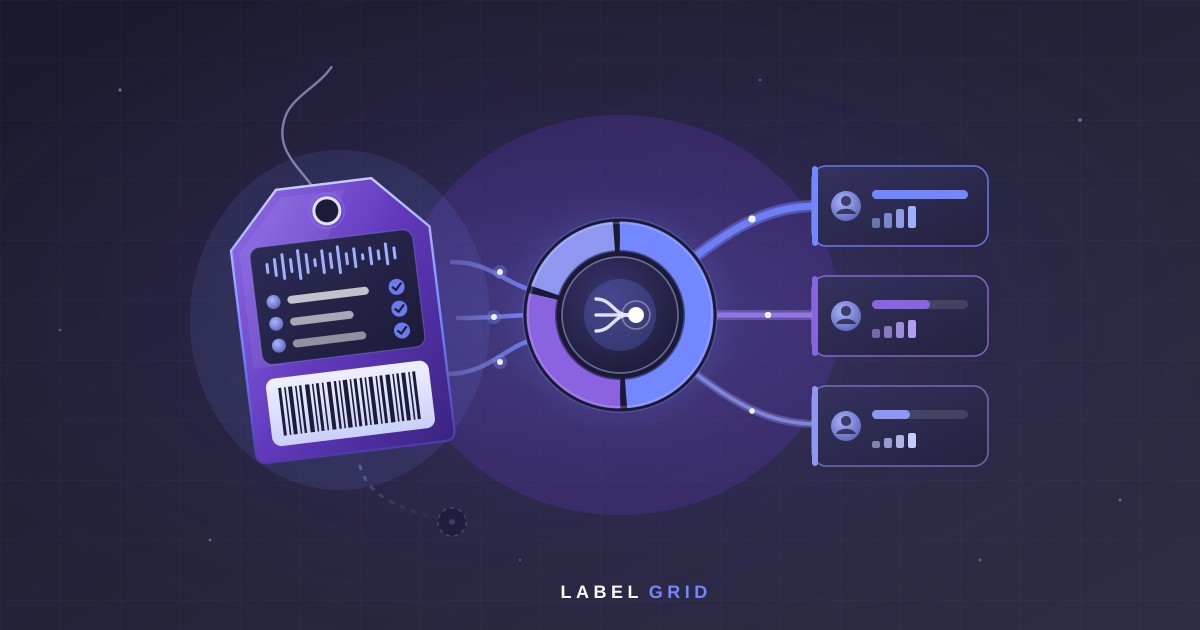
The match leans on a small set of identifiers, each doing one job. The ISRC names the specific recording, while the ISWC names the underlying composition and the UPC ties the release together. Splits then assign percentages to the parties on each side: writer and publisher shares in the work registration, recording-revenue shares at the distributor. The identifiers are join keys: get them right and the money lands on the correct row; get one wrong and the join either fails or quietly lands on someone else’s. The splits then decide how that row is divided.
This is why how you manage your catalog is a revenue function, not an administrative one. The catalog is the lookup table every future payment runs against.
Where the Money Actually Leaks
Leaks are rarely dramatic. They are small, specific, and easy to miss at upload. Four show up again and again.
- Wrong split percentages. The 8% example above is the clean illustration. A share entered wrong is not something a later rate adjustment ever catches; it simply keeps paying out at the wrong number, every period, for as long as the song earns.
- Missing or duplicate ISRCs. A duplicate can split royalties across unrelated recordings or send them to the wrong owner. A missing one can get a release rejected before it earns a cent.
- Unregistered works. If the composition was never registered with the relevant society, the publishing side of the money has nowhere to match to. It sits in the unmatched pool until the work is registered and matched, and at The MLC, money that is never matched will eventually be distributed to other rightsholders by market share, not to you.
- Mismatched contributor IDs. When a performer or writer is identified inconsistently across releases, their share can be routed to the wrong party or left with no payee.
Most of these do not show up as an error on your statement. The defining feature of a metadata leak is that the missing money simply is not there; you have to go looking for it in the collecting society’s unmatched data.
Identification Is the Foundation, Not the Rate
The industry’s own infrastructure is moving in this direction. SoundExchange built the infrastructure behind IFPI’s automated ISRC assignment system, announced jointly with IFPI in June 2026.
“Reliable, standardized identification is foundational to a fair and efficient music industry.”
Michael Huppe, President and CEO, SoundExchange
New revenue streams make the point sharper. In June 2026, Chordal added 21 partners to its pre-clearance licensing platform, and its CEO Grayson Sanders described the driver as demand for “better infrastructure to participate in the emerging global micro-licensing business.” In a separate statement he said the wider partner base has “enabled us to connect more dots between co-rights holders to provide fully clearable music” to its licensees. Pre-clearance runs on knowing who holds each share of a song. That is exactly what metadata records.
You can win every rate argument and still lose money if the identification underneath is broken. Identification decides whether you are even in the room when the money is distributed.
Make your catalog collectible
LabelGrid delivers to all major DSPs with DDEX-standard metadata and free ISRC codes you keep. 7-day free trial.
See PlansWhy a Single Error Compounds Silently
A metadata mistake is not a one-time loss. The match runs again on every reported use, every reporting period, in every territory, for as long as the recording earns. So an 8% share that should read 16% is not a single missed payment. It is a recurring discount applied to every future payout until someone corrects it.
Now multiply that across a catalog. A label with hundreds or thousands of tracks does not have one split to check. It has thousands, plus thousands of ISRCs, contributor IDs, and registrations, each an independent chance for a small, recurring leak. The errors do not announce themselves. They sit in the data, paying out slightly wrong, year after year. By the time anyone notices a pattern, a great deal of money can already have failed to arrive.
This is the difference between owning a catalog and owning a catalog you can get paid on. The first is a list of recordings. The second is a clean, matchable asset that collects reliably. Clear royalty accounting and splits are what keep the second from quietly decaying into the first.
How Clean Delivery Makes a Catalog Collectible
Collectible is a property of the data, not the music. Three things make a catalog collectible, and a good distribution setup handles all three so you do not have to engineer them by hand.
First, standardized delivery. DDEX is the family of messaging standards that record companies, distributors, DSPs, and music licensing organisations use to exchange release information. Delivering to DDEX ERN means your identifiers and credits arrive in one industry-standard structure the receiving platforms are built to read. LabelGrid’s distribution handles that delivery as standard.
Second, durable identifiers. LabelGrid provides ISRC and UPC codes at no extra cost, and they stay yours even if you move to a different distributor later. Already have codes from a previous setup? Enter them at release creation with the same artist, title and release metadata. Matching codes plus matching metadata keep your existing stream counts, playlist placements, and chart history attached to the same identifier instead of starting over under a new one.
Third, accurate splits at the source. Setting contributor percentages correctly when the release is created, rather than patching them after the fact, means the very first payout is calculated on the right numbers. Splits on the recording side, set per release or per track, govern the recording revenue your distributor pays out; a writer’s share is set in the work registration at your PRO or The MLC, so both need to be right. For labels managing other people’s catalogs, that accuracy is the product. It is why label-grade tooling treats splits and writer credits as release-blocking details, not optional fields.
A Metadata-Hygiene Checklist for Every Release
You do not need an audit team to close most leaks. You need a routine. Run this before you deliver, and again after the first statement lands.
- Confirm every contributor split adds to 100% and that each percentage reflects the actual agreement, not a default.
- Verify the ISRC on each recording is unique and correct, and reuse it only for the same recording; a remix, edit or new take needs its own code.
- Check that every composition is registered with the relevant society so the publishing side has somewhere to match.
- Use one consistent identity and spelling for each contributor across the whole catalog. Shares then accumulate instead of fragmenting.
- Use a distributor that delivers to DDEX standards so the data arrives in the structure DSPs expect.
- After the first reporting period, reconcile the statement against what you expected to match. A line missing entirely points to identification, not the rate.
That last step matters most. An all-zero or smaller-than-expected payout is not always “the music underperformed.” Sometimes it is a match that never happened.
Frequently Asked Questions
What is music metadata royalty accounting?
It is the practice of treating your metadata, the identifiers and credits attached to a release, as the foundation of what you get paid. Royalties are matched to recordings and works using codes like ISRC and ISWC, then divided by contributor splits. If those are wrong or missing, the money either does not match to you or matches at the wrong percentage. Clean metadata is what makes a catalog collectible.
How does an ISRC error affect my royalties?
A duplicate ISRC can cause royalties to be split between unrelated recordings or misdirected to someone else. A wrong ISRC can credit your streams to a different rights holder entirely. A missing ISRC can cause platforms to reject the release before it ever earns. Because the same code rides on every reported use, one error repeats on every statement until it is corrected.
Why do metadata errors compound over time?
A royalty match runs on every reported use, every reporting period, across every territory, for the life of the recording. A split set to the wrong percentage or a work that was never registered does not fail once. It under-pays on every statement until it is corrected, and it does so quietly, because the money that never matched does not appear on your statement. You have to go looking for it, for example in The MLC’s Matching Tool.
What is DDEX and why does it matter for getting paid?
DDEX is a family of messaging standards that record companies, distributors, DSPs, and music licensing organisations use to exchange release metadata, deal terms, and usage reports. Delivering to DDEX standards means your identifiers and credits arrive in one industry-standard structure the receiving platforms are built to read. LabelGrid supports DDEX ERN 3.8.2, 4.3.0, 4.3.1 and 4.3.2 and handles DDEX delivery to DSPs on your behalf.
Does LabelGrid provide ISRC and UPC codes?
Yes, at no extra cost, and they are yours to keep even if you later switch distributors. You can also enter codes you already own during release creation. With matching metadata, that keeps your existing streaming history and chart data intact instead of resetting it under a new identifier.
Getting Started
Pick one release and run the checklist above on it today. Confirm the splits, verify the ISRCs, check that the works are registered. It takes a few minutes and tells you fast whether your catalog is collecting cleanly or leaking quietly.
When you are ready to deliver on metadata that matches the first time, start a release in the LabelGrid app, or read the help doc on ISRC and UPC codes. Clean data is the cheapest revenue you will ever add, because it is money you were already owed.