Music royalty accounting software ingests streaming and sales data, matches it to the right tracks and rights holders, calculates what each party is owed, and produces statements and payouts. It replaces spreadsheets that break as a catalog grows, turning raw DSP reports into accurate, auditable royalty accounting for labels, distributors, and rights administrators.
Royalties arrive from many sources in many formats. Spotify, Apple Music, YouTube, and dozens of others each report differently, in different currencies, on different schedules. Royalty accounting software normalizes all of it, applies the contracts and splits you’ve configured, and tells each artist, songwriter, or collaborator exactly what they earned. Done by hand, this is where money goes missing.
This guide explains what the software actually calculates, who needs it, how to choose it, and where LabelGrid’s accounting fits.
What does royalty accounting software actually calculate?
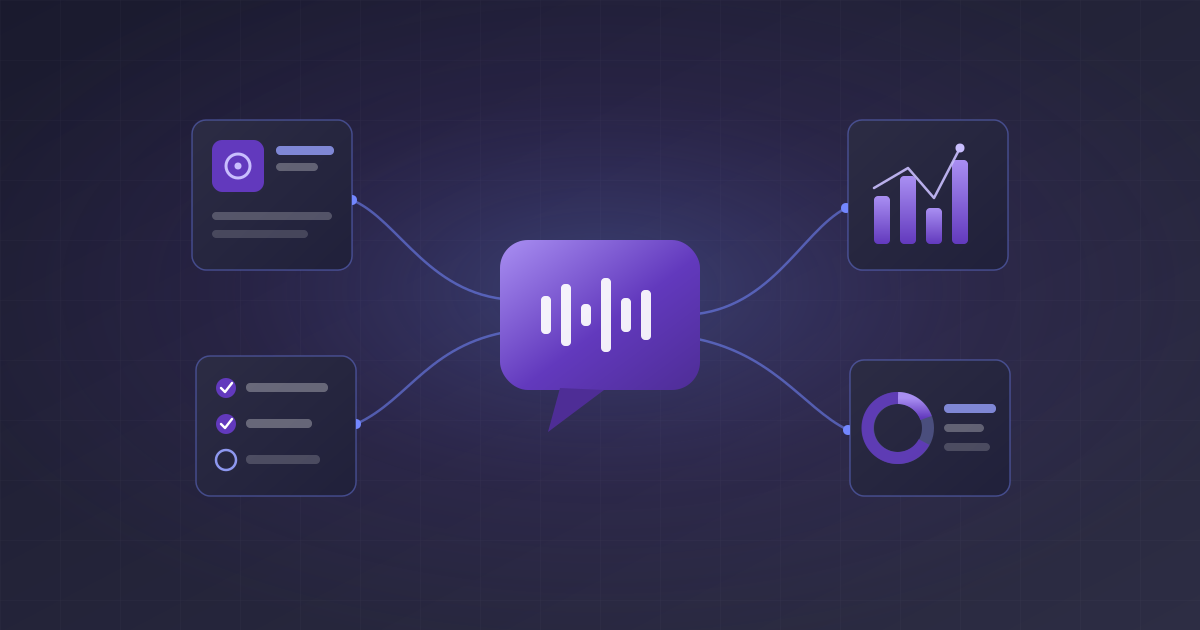
It takes raw earnings data and resolves it into per-party amounts. The core steps:
- Ingestion. Import DSP reports and sales data, in each platform’s format and currency.
- Matching. Map each line of earnings to the correct release, track, and rights holder using identifiers like ISRC.
- Splits. Apply the agreed percentages between a label and its artists, or among collaborators on a track.
- Deductions and fees. Subtract distribution fees, advances to recoup, and any contractual deductions.
- Currency conversion. Normalize multi-currency earnings into the payout currency.
- Statements and payouts. Generate transparent statements per artist and trigger payouts.
The matching step is where accuracy lives or dies. Unmatched royalties are a real, measurable problem: the Mechanical Licensing Collective received over $424 million in unmatched “black box” streaming royalties to redistribute (The MLC, via Billboard). Software that matches earnings reliably to rights holders is what keeps money from disappearing into that gap.
LabelGrid’s accounting handles this end to end: it ingests DSP data, applies automated royalty splits, and produces per-artist statements with transparent breakdowns by DSP, release, and track.
Who needs music royalty accounting software?
The need scales with how many parties you owe and how many sources you collect from. A solo artist with one revenue stream can read a dashboard. Beyond that, manual accounting breaks down:
- Labels paying multiple artists across a catalog, each with their own contract and split.
- Distributors and white-label operators accounting to many clients from one pool of DSP earnings.
- Artists with collaborators who need automatic per-track splits to producers, featured artists, and co-writers.
- Rights administrators reconciling royalties across catalogs and territories.
This matters most in the independent sector, which now holds 46.7% of the recorded music market on an ownership basis (MIDiA Research, 2023). Independents don’t have a major label’s back office, so the software is the back office.
Why do spreadsheets stop working for royalty accounting?
Spreadsheets are fine for one artist and one DSP. They fail predictably as complexity grows:
- Format chaos. Every DSP reports differently. Reconciling formats by hand introduces errors with every new source.
- Split drift. When a track has three collaborators and a label cut, one wrong cell pays the wrong person.
- Currency mistakes. Manual conversion across territories compounds rounding and rate errors.
- No audit trail. When an artist disputes a statement, a spreadsheet can’t show how the number was derived.
- It doesn’t scale. Streaming is 69.6% of recorded music revenue (IFPI Global Music Report 2026) and arrives continuously, so a monthly spreadsheet rebuild can’t keep up.
Run royalty accounting alongside distribution
Statements, splits, and payouts built into the same platform that delivers your catalog. 7-day free trial.
See PlansHow to choose royalty accounting software
Match the tool to how you actually collect and pay. Use this checklist.
| Criterion | Why it matters |
|---|---|
| Multi-source ingestion | Pulls from all your DSPs and sales channels, in their native formats. |
| Automated splits | Applies label and collaborator percentages without manual cell editing. |
| Multi-currency support | Normalizes territory earnings into one payout currency accurately. |
| Transparent statements | Per-artist breakdowns by DSP, release, and track, so disputes are answerable. |
| Integrated payouts | Pays artists directly rather than exporting to a separate system. |
| Distribution integration | Accounting tied to the same platform that delivered the release removes a reconciliation step. |
| Audit trail | Every number traceable to its source line of earnings. |
A practical decision path:
- List your inputs. Which DSPs and sales channels feed your royalties, and in which currencies.
- List your outputs. How many parties you pay and how their splits are structured.
- Decide standalone vs integrated. Standalone royalty tools account for data from anywhere; integrated platforms account for what they also distribute, removing an import step.
- Test with real data. Run a recent month through a trial and check the statements match what you’d compute by hand.
- Check payout coverage. Confirm the tool pays your artists in their currencies on your schedule.
Standalone royalty tools vs distribution-integrated accounting
Two models exist. A standalone royalty platform ingests data from any distributor and focuses purely on accounting. A distribution-integrated platform handles both delivery and accounting in one place, so earnings reconcile against releases you already control.
The integrated model removes the export-import step between your distributor and your accounting tool, and keeps identifiers consistent because the same platform created the release and ingests its earnings. LabelGrid takes the integrated approach: it distributes to all major DSPs and accounts for the resulting royalties in the same system, with monthly payouts, plus automated splits and multi-currency artist payouts from the Basic plan up. Pricing is published, with a 7-day free trial to test it against your own data.
Can an AI assistant work with your royalty data?
Increasingly, yes. Instead of exporting statements and uploading spreadsheets to a chatbot, some platforms now expose royalty and catalog data to AI assistants directly. LabelGrid ships an official open-source MCP server that connects Claude, Cursor, or any MCP-compatible assistant to your account, so you can ask for last quarter’s statement broken down by label or this week’s streams by store and get answers from your live data. Access is read-first and fail-closed: reads are always available, while consequential actions stay off until you explicitly enable them.
Music royalty accounting software: the bottom line
Royalty accounting software turns messy multi-source DSP data into accurate per-party statements and payouts by ingesting earnings, matching them to rights holders, applying splits, and paying out. Labels, distributors, collaborators, and rights administrators all outgrow spreadsheets, and the choice comes down to multi-source ingestion, automated splits, transparent statements, and whether you want accounting integrated with distribution. LabelGrid’s accounting and royalty-splits features handle both in one platform. Try them with a free trial before you commit.
Frequently Asked Questions
What does music royalty accounting software do?
It imports streaming and sales data from your DSPs, matches each line of earnings to the right track and rights holder, applies the splits and deductions you’ve set, converts currencies, and produces per-artist statements and payouts. It replaces manual spreadsheets that break as a catalog grows.
Who needs royalty accounting software?
Anyone paying more than themselves from more than one source: labels accounting to multiple artists, distributors accounting to clients, artists splitting earnings with collaborators, and rights administrators reconciling catalogs. A single artist with one revenue stream can usually read a dashboard instead.
Can’t I just use a spreadsheet for royalty accounting?
For one artist and one DSP, yes. Beyond that, spreadsheets fail on format differences between DSPs, split errors, manual currency conversion, and the lack of an audit trail when an artist disputes a statement. They also can’t keep pace with continuous streaming data at scale.
What’s the difference between standalone and integrated royalty accounting?
Standalone tools ingest royalty data from any distributor and focus only on accounting. Integrated platforms handle distribution and accounting together, so earnings reconcile against releases the same system delivered, removing an import step and keeping identifiers consistent. LabelGrid uses the integrated approach.
Does royalty accounting software handle splits and payouts?
Good software applies collaborator and label splits automatically and pays each party directly. LabelGrid includes automated royalty splits and multi-currency artist payouts from the Basic plan up, plus monthly payouts, so accounting and payment happen in one place.
How does royalty matching prevent lost income?
Matching maps each line of DSP earnings to the correct rights holder using identifiers like ISRC. Poor matching is why hundreds of millions in royalties go unclaimed industry-wide. Software that matches reliably ensures earnings reach the right party instead of sitting unallocated.