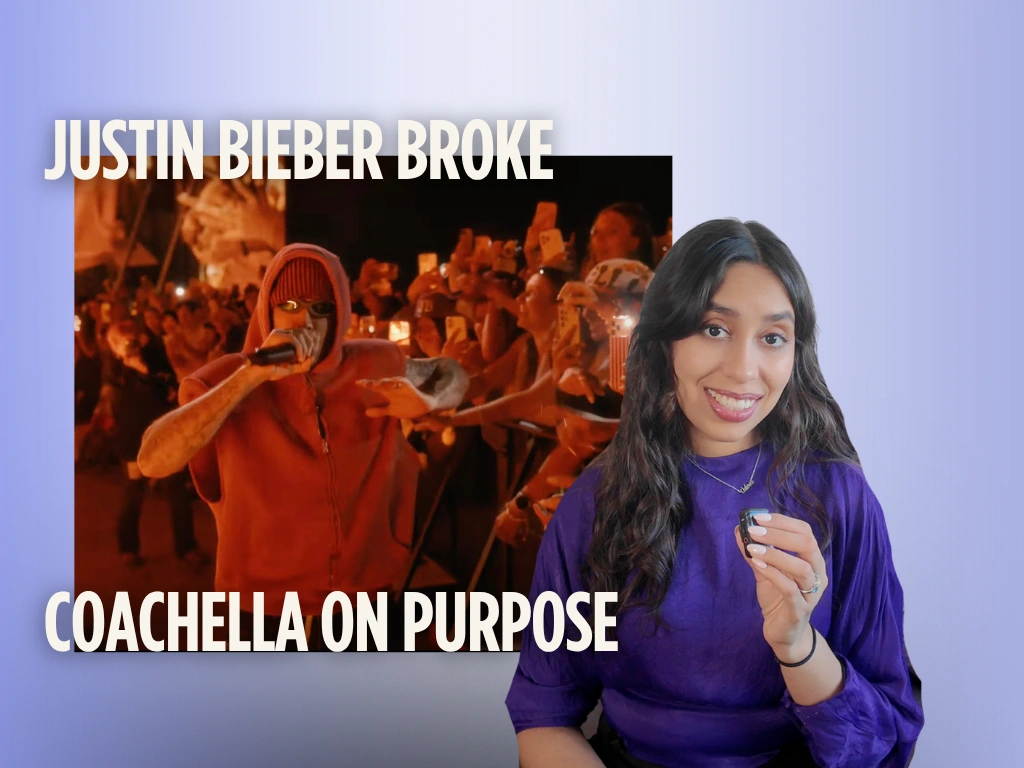
Justin Bieber’s 2026 Coachella set looked like a disaster to some and a revelation to others. Hoodie, desk, laptop, YouTube on screen. No fireworks, no huge dance team, no $50 million spectacle.
But underneath the “low-effort” optics was one of the sharpest examples of modern music strategy you’ll see as an independent artist or label.
This wasn’t an accident. It was a blueprint.
The Anti-Spectacle: Why Doing Less Worked
We’re in an era where most live shows are overproduced. Perfect lighting, flawless choreography, synced visuals. And because everything is optimized, much of it feels interchangeable.
Justin Bieber flipped that script with what you could call an anti-spectacle:
- A simple setup: a desk, a laptop, old YouTube videos on a big screen
- Real-time reactions and laughter at his younger self
- Moments that felt slightly unpolished and unpredictable
That stripped-back approach created something rare at large festivals: proximity. He stopped feeling like a distant pop machine and started feeling more like someone watching old clips with friends.
For independent artists, there’s a clear lesson. High connection can beat high production. Fans respond to something that feels human, not just huge.
Nostalgia as a Growth Engine
Justin wasn’t just being sentimental. He was activating nostalgia on purpose.
By revisiting early content and viral moments from his rise, he triggered emotional memory for fans who grew up with him. That kind of nostalgia usually leads to predictable behaviors:
- Fans streaming old tracks and albums
- Search spikes for his name and early songs
- Clips shared across social platforms with comments like “I remember this era”
For your own career, think of nostalgia as a strategic tool. Old mixtapes, early demos, first videos, behind-the-scenes footage – all of this can be reframed later to spark rediscovery of your catalog.
The Real Audience: Algorithms, Not Just the Festival
Justin Bieber was not just performing for 100,000 people in the desert. He was performing for millions of people who would only ever see the show through clips.
Modern performances are judged by how they travel online, not just how they feel in the moment. That’s where this performance becomes a masterclass in platform awareness.
Designing for Clip Velocity
A huge, tightly choreographed performance might impress live. But what spreads faster online?
- Short moments where Justin scrolls, pauses, laughs, or reacts
- Lines that can be quoted and memed instantly
- Visually simple, emotionally loaded shots that are easy to crop and share
Rather than aiming for one flawless, cinematic set, he created dozens of imperfect, shareable moments that fit TikTok, Reels, and Shorts natively.
This is platform literacy: understanding that you’re not just playing a show, you’re creating raw material for algorithms.
If you want to go deeper on designing for recommendation systems, read our breakdown of Spotify’s new personalization era and what artists need to know. The same thinking applies: build for how content is discovered, not just how it is made.
The SWAG Era and the Independence Play
Beyond the creative choices, the Coachella set was tightly linked to Justin’s recent eras, including SWAG and SWAG II. The performance worked as a live rollout and funnel.
Frictionless Consumption
There was no long promo build. No extended teaser campaign. The music was simply available as attention peaked. Fans leaving the livestream or festival could immediately go find the songs and projects referenced or teased during the show.
For independent artists, this is a powerful model:
- Align key performances or live moments with releases that are already live or about to drop
- Reduce the gap between attention and listening
- Turn every big appearance into a direct path back to your catalog
Cutting Out Middle Layers
Reports suggest Justin bypassed some traditional agency structures, working more directly with festival promoters. Combine that with minimal production and you get:
- Lower overhead on the performance
- Higher margins from the appearance
- Greater control over how the show was positioned and filmed
This is what it looks like when an artist starts to function as an independent infrastructure – a self-contained system that can negotiate, perform, release, and monetize with fewer intermediaries.
If you’re building toward that kind of control, it helps to understand how the wider release and distribution landscape is shifting. Our guide on the evolving music distribution landscape breaks down the structural changes every indie should understand.
The Bieber Brand Ecosystem: Coachella as a Storefront
Bieberchella was not just a concert. It was a live demonstration of how to turn attention into a complete brand ecosystem.
Vertical Integration on Stage
Instead of promoting external luxury labels, Justin wore his own brand. That is vertical integration: your art creates demand that feeds your own products, not someone else’s.
During the livestream, that visual branding connected directly to:
- Merch and product lines tied to his current creative era
- Search behavior for his brand name and designs
- Social screenshots and photos that double as unpaid advertising
Viewers see it and can act on it instantly. That’s see now, buy now in a live music context.
A Shared Ecosystem: Justin and Hailey
At the same time, Hailey Bieber and her brand Rhode activated on-site through experiences and influencer presence. The result was a multi-layered brand event:
- Music drives attention
- Attention introduces or reinforces brand identity
- Brands capture revenue and data beyond streaming
For independent artists and labels, the takeaway is straightforward: streaming is one revenue stream, not the entire business. Building a self-contained ecosystem of products, experiences, and content around your music is where long-term stability comes from.
For inspiration, explore how other artists have done this at scale in our piece on genius album launches and modern rollout strategies.
Legacy Repositioning: Merging Past and Present
Beneath the virality, this set also served a deeper purpose: reframing Justin Bieber’s legacy.
For years, he has lived between two versions of himself:
- The teenage phenomenon defined by early viral hits
- The adult artist searching for artistic evolution and credibility
By sitting on stage with his younger self playing behind him, he took control of that narrative. He acknowledged the teenage era instead of running from it, and then used the present performance to show where he is now.
The result: continuity. He becomes a cultural operator, not just a nostalgic act or a rebooted pop star.
Independent artists can borrow this move during rebrands or pivots. Instead of deleting or ignoring your past work, you can frame it, comment on it, and fold it into your current narrative.
Key Lessons for Independent Artists and Labels
Bieberchella is not about having Justin Bieber’s budget or scale. It’s about understanding the logic behind the choices and translating them to your level.
1. Production is optional, connection is not
Big production can help, but it is no longer the unique advantage. Fans crave moments that feel present, imperfect, and honest. A simple setup with strong storytelling can outperform a massive, detached spectacle.
2. Design for platforms, not just for the room
When planning any performance or content piece, ask:
- What are the 3–5 moments that people will clip and share?
- What lines, visuals, or reactions are built for vertical video?
- How can this set live again tomorrow as short-form content?
If it doesn’t clip, it likely won’t travel.
3. Use nostalgia as a growth tool
Nostalgia is not just sentimental. It can drive:
- Catalog streams and royalty spikes
- Re-engagement from lapsed fans
- New fans discovering your history through viral throwbacks
Schedule “past era” content intentionally around new releases or major performances to reopen old chapters on your own terms.
4. Build and own your ecosystem
The most resilient careers are built on multiple, interconnected pillars:
- Recorded music and catalog
- Live performances and special events
- Merch, products, and brand collaborations
- Digital content designed for algorithms
The closer you are to owning each layer, the more freedom and leverage you have.
5. Control perception, not perfection
The set did not aim to be technically perfect. It aimed to shape the conversation. People argued about whether it was lazy or brilliant – but they talked, posted, and watched.
For your own work, focus less on flawless execution and more on what the performance communicates about who you are and where you’re heading.
From Spectacle to Strategy
Bieberchella challenged what a headlining performance is supposed to look like. It traded fireworks for feed dominance, choreography for clip moments, and maximal production for maximal intention.
For artists, managers, and indie labels, this is a signal: we are moving from the era of spectacle to the era of strategy.
If you want more real-world breakdowns of how top artists are playing the long game, explore campaigns like Olivia Dean’s intentional artist growth strategy and how she turned careful planning into sustainable momentum.
Use these lessons as a lens for your next release, tour, or live video. Ask what Justin Bieber did at Coachella, then scale the logic to your own world.