When you distribute internationally as a label based outside the United States, the technology does not change. You reach global streaming services and regional ones over the same standardized DDEX supply chain that a US label uses, so no DSP is closed to you because of where your company sits. What changes is everything around the delivery: which rights you actually control territory by territory, how money reaches you across currencies and slower payment rails, the withholding-tax questions that only your own advisor can answer, and the native-language metadata that decides whether a release performs in each market.
That gap between “the pipes are the same” and “the operations are different” is where non-US labels quietly lose time and money. A US-centric guide tells you to upload, pick your stores, and wait for royalties. It will not warn you that a payout method fine for a US bank account can carry a higher minimum for an overseas one, that a Korean or Chinese release lives or dies on its original-script metadata, or that “worldwide” in a contract is a rights claim you have to be able to back.
This guide walks those differences at a general level. It is educational information, not legal, financial, or tax advice, and it ends with a checklist you can take into any distributor conversation. It pairs with our look at the economics of newer streaming markets in the emerging-markets ARPU guide, which covers why a stream pays differently region to region. Here the focus is operations: the mechanics of getting music out and getting paid from abroad.
Rights and Territory: What You Can Distribute, and Where
Distribution rests on one rule that has nothing to do with technology. You can only distribute rights you own or have been authorized to distribute, and those rights are territorial. Getting this right is more of the job than any upload screen, and it is the part a non-US label most often has to think about harder than a US one.
- Two rights layers sit inside every release, and they are always separate. The sound recording, the master, is usually what a label controls. The underlying composition, the songwriting and publishing, is cleared through collective-management organizations in each territory. They pay through different channels, so a distributor moving your recordings does not, by itself, administer your publishing.
- Territory is expressed in the delivery itself. In the DDEX feed, availability lives in the Deal, scoped as Worldwide, an included-territory list, or Worldwide minus specific excluded territories. Only offer the territories where you actually hold the rights.
- Clear samples, covers, and controlled compositions before you deliver, not after. A clearance that is fine in one market may not hold in another, and territorial licensing differences are exactly the kind of thing that surfaces as a takedown once a release is already live.
- Moving an existing catalogue is a rights and exit event in its own right. If you are switching distributors, plan the takedown from the old one and the redelivery to the new one so your identifiers and release history carry over cleanly.
Being outside the US does not change any of this. It mostly means your publishing and collection-society layer sits with your home country’s societies rather than the US ones, which is normal and expected. The fundamentals of what you can distribute, and where, are the same wherever your label is registered.
Delivery to Global and Regional DSPs Runs on the Same Rails
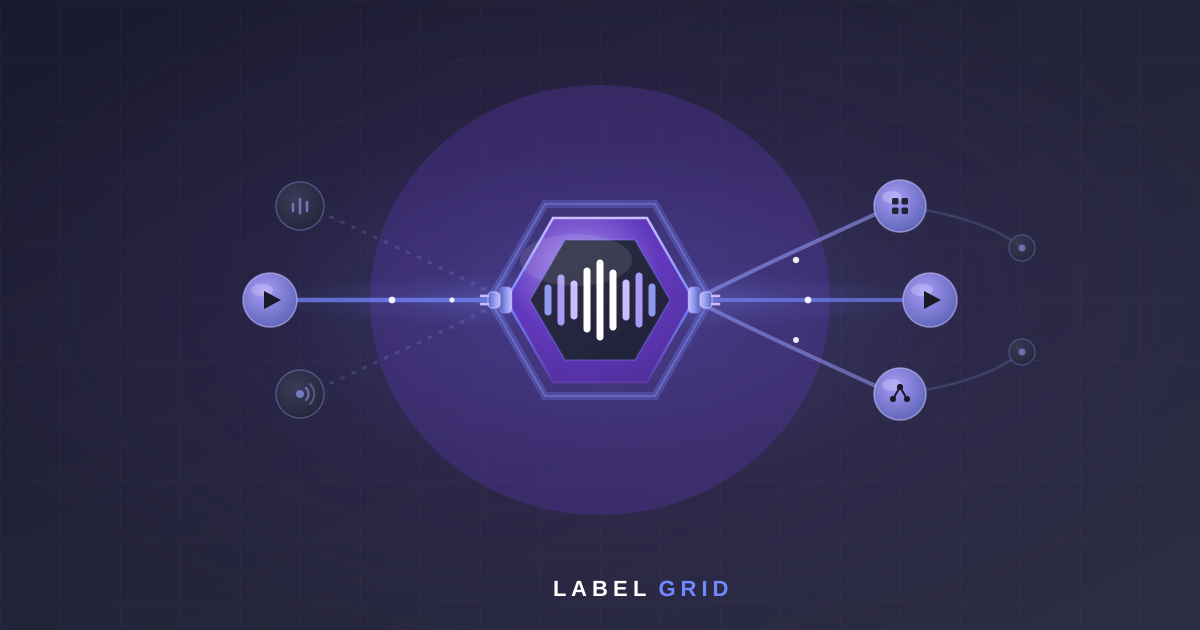
There is no separate “international protocol” and no premium pipe for reaching listeners abroad. Global majors and regional services are reached over the same standardized DDEX supply chain, whether your label is in Berlin, Lagos, Seoul, or Nashville.
- Releases go out as a DDEX ERN message, the Electronic Release Notification, which tells each DSP about the release, its deal terms, and its territorial availability. LabelGrid delivers over the current ERN versions, 3.8.2 and the 4.3.x family.
- You do not need to run your own DSP integrations. A label that does not exchange DDEX messages itself is allocated a DDEX Party Identifier and delivers through its distributor, which acts on its behalf. That is exactly how a non-US label reaches both global and regional platforms without building anything.
- Reporting comes back the same way, as DDEX sales reports (DSR), which carry different profiles for different kinds of content and reporting processes, with usage reported across commercial models like subscription and ad-supported. Those reports are the raw material your statements are built from.
- Regional services reach audiences the global majors under-serve, and where a distributor delivers to them, they ride the very same rails.
In practice, LabelGrid delivers to all major DSPs (Spotify, Apple Music, Amazon Music, YouTube Music, Deezer, TIDAL and the rest) and, where they matter to your audience, regional platforms including AWA in Japan, FLO in Korea, JioSaavn in India, KKBOX in Taiwan and Hong Kong, NetEase and the Tencent QQ Music ecosystem in China, Boomplay across Africa, and Anghami in the Middle East and North Africa. The point is not the length of a list. It is that the same account and the same delivery reach a global audience and a regional one, so your job is to pick the coverage you need, not to wire up each platform yourself.
So the real differences a non-US label feels are not in the mechanics. They are in which territories you license, which regional services your distributor actually reaches, and the money and metadata realities in the next two sections.
Getting Paid Across Currencies Takes Longer and Costs More to Reach You
Money from global streaming does not arrive instantly, in one piece, or in one currency. Three general realities apply to any overseas payee. The specific figures are contract-specific, so confirm them with your distributor rather than assume them.
- Payment lags usage, always. DSPs report and pay in arrears, and every link in the chain adds delay, so months can pass between a stream and the payout that corresponds to it.
- Thresholds depend on the payment route, and non-US routes can cost more. Payers set a minimum accrued balance before they release money, and the floor rises with the cost of the payment rail. The MLC, for example, documents a US ACH floor of $5 against a $100 floor for a non-US local bank transfer. Balances below the threshold are carried forward, not lost.
- Currency conversion and reserves change what actually lands. Earnings booked in one currency and paid in another go through a foreign-exchange conversion, and some payers hold reserves against later adjustments. The payout methods, settlement currency, conversion approach, and fees vary by distributor, so treat them as things to confirm, not defaults.
Whatever the terms, the practical consequence is the same. Your accounting has to reconcile a stream of small, delayed, multi-currency line items into something an artist can actually read. That is what royalty accounting is for. LabelGrid royalty accounting keeps statements, expenses, and recoupment in one connected system, and automated splits divide each payment the way a deal says they should, so a per-artist statement shows what was earned, what was recouped, and what is payable. For a label running a roster from abroad, that reconciliation is most of the label back-office work, and it is the part that turns a pile of foreign-currency micro-payments into numbers you can trust.
Distribute worldwide and account for every royalty in one place
Reach the global majors and the regional services that matter, keep your masters, and reconcile multi-currency payouts into clear per-artist statements.
See PlansMetadata and Language Do More Work Abroad
Metadata is what makes a release discoverable and payable in each market, and for international releases it carries more weight than many labels expect. The identifiers are universal. The language fields are where the regional work lives.
- Keep your identifiers correct and stable. ISRC identifies the recording, UPC the release, ISWC the composition, and ISNI disambiguates an artist’s identity. They are the spine of matching, settlement, and de-duplication across every DSP and collection society, and consistent identifiers reduce cross-border friction more than almost anything else you can control.
- Deliver metadata in the release’s original language and script, consistently. Native-script fields (Chinese, Japanese, and Korean title, artist, and writer names, plus time-synced lyrics where relevant) are a first-class expectation in several Asian markets, not a nice-to-have. Korea’s collection society, KOMCA, runs a work-identifier system built to process non-roman Hangul characters, which is one reason accurate native-script writer data reduces settlement friction there. In India, accurate primary and regional-language tagging is a high-value discovery field.
- Get the copyright lines and dates right. Accurate P-line and C-line (the year and the owner) and any territory-specific metadata drive both how a release displays and how its rights are handled.
- Plan release dates across time zones. A single “global release date” resolves to different local moments around the world, so schedule with date and time in mind if you want a coordinated worldwide go-live.
Regional services also keep their own clocks and ingest on their own schedules, so allow extra lead time before a scheduled release date. Plan Asian releases with the same forward scheduling you would use for the global majors, and get native-script metadata right up front, because it is the discovery and settlement spine in these markets and is expensive to correct after the fact. Metadata corrections in distributor-fed markets like India flow back through the distributor rather than a platform screen, so accuracy at delivery time is what governs how a release appears.
Tax on Cross-Border Royalties: One Line, Then Talk to Your Advisor
Tax is the one area where general guidance is worse than none. Cross-border royalties can be subject to withholding tax at source, an applicable tax treaty between your country and the source country may reduce it, US-sourced income commonly involves forms in the W-8 family, and your own registration, VAT or GST, and reporting duties depend on local law and how your business is structured. None of that is advice, and none of it should be treated as your situation. Establish what actually applies to you, and any treaty benefit you can claim, with a qualified tax professional in your jurisdiction before you rely on it.
What to Verify With Any Distributor Before You Sign From Abroad
The real international differences are contract-specific, which means they are questions to ask, not defaults to assume. Before you commit a catalogue to any distributor from outside the US, confirm these directly, and do not accept a bare “we go everywhere.”
- Coverage that matters to you. Which DSPs and which territories the distributor actually delivers to. Name the platforms and regions you care about and get a yes or no on each, rather than a blanket claim.
- Rights retention. That you keep ownership of your masters and the distributor is delivering your rights, not acquiring them. Check exclusivity, term, and territory scope in writing.
- Payout mechanics. The payment methods available in your country, the settlement currency and how foreign exchange is handled, the minimum thresholds, the payout frequency, and any fees or reserves.
- Reporting. The cadence, format, and granularity (per DSP, per territory), and how the usage they report maps to the money you receive.
- Publishing. Whether the distributor administers your composition and publishing rights or only the recording, since the two are separate and easy to assume are covered when they are not.
- Exit and catalogue transfer. How you take your catalogue elsewhere later, including takedown and identifier continuity, so you are not locked in by friction.
- Support across time zones. How issues get handled when your working hours do not overlap the distributor’s.
If you are going a step further and want to run distribution under your own brand, for your own artists or a set of sub-labels, that is a white-label model rather than a plain distribution account, and it comes with its own version of these questions. Our guide to white-label music distribution covers what that involves. Either way, the labels that do well internationally are the ones that treated coverage, payouts, and metadata as things to verify up front, and kept their royalty accounting clean enough to actually trust the numbers coming back.
Frequently Asked Questions
Do I need a US company to distribute music internationally?
No. Distribution runs on the same standardized DDEX supply chain regardless of where your label is based, and a label that does not exchange DDEX messages itself still delivers through its distributor. What you do need to get right is which territories you actually hold rights in, plus any tax paperwork your own advisor tells you applies. Being outside the US does not lock you out of any DSP.
Can I get paid in my own currency?
It depends entirely on your distributor. Settlement currency, the payout methods available in your country, foreign-exchange handling, minimum thresholds, and fees vary by provider and are contract-specific, so there is no universal answer. Ask any distributor directly which methods and which currency they support for a payee in your country before you sign.
Do regional DSPs actually matter, or is Spotify enough?
In several markets the local-champion services carry audiences the global majors under-serve. LabelGrid delivers to the global majors and, where relevant, regional platforms such as AWA in Japan, FLO in Korea, JioSaavn in India, KKBOX in Taiwan and Hong Kong, and the Chinese services. Whether they matter depends on where your listeners are; if you release music aimed at those regions, the regional services are often where the listening happens.
Does my label keep its rights when a distributor delivers worldwide?
With a standard distribution arrangement, yes: the distributor is delivering your recordings, not acquiring them, so you keep ownership of your masters. Confirm the specifics in the agreement anyway, exclusivity, term, and territory scope, and remember that your recording rights and your publishing (composition) rights are separate, so check whether the distributor touches publishing at all.
How do royalties flow back from international DSPs?
DSPs report usage and sales back up the chain through DDEX sales reports, and each link adds delay, so expect months between a stream and the matching payout. The money can arrive net of foreign-exchange conversion, reserves, and per-DSP or per-territory reporting differences, which is why reconciling it into a clear per-artist statement is its own job. LabelGrid royalty accounting is built for that reconciliation.
What metadata differs for international releases?
The identifiers are the same everywhere (ISRC for recordings, UPC for the release, ISWC for the composition, ISNI for artist identity), but native-language and native-script fields carry more weight abroad. Chinese, Japanese, and Korean title, artist, and writer fields, and accurate regional-language tagging in markets like India, are first-class discovery and settlement data in those regions, not an afterthought, and they are expensive to fix after delivery.