Labels get music onto Asian streaming platforms the same way they reach Spotify or Apple Music, through a distributor that delivers the release over standard DDEX rails to each service. The catch is that Asia’s biggest platforms sit outside the Western streaming bundle, so the distributor has to hold a separate delivery route into each one. Where those routes exist, the QQ Music ecosystem, NetEase Cloud Music, FLO in Korea, AWA in Japan, KKBOX across Taiwan and Hong Kong, and JioSaavn in India are all reachable from a single upload, with the same identifiers, provided the metadata is clean and, where it counts, in native script.
That one difference, separate routing per platform, is why “distribute to Asia” is a different conversation from “distribute everywhere.” The global majors already serve Asian territories, but the region’s local champions run their own licensing, their own catalogs, and in several cases their own ingest systems. This guide maps the reality market by market: which platforms a distributor like LabelGrid actually delivers to, which ones need a route we do not currently provide, what the metadata and localization expectations are, and how a release physically gets there.
It also draws a clear line where one belongs. A few well-known Asian services are not reachable through LabelGrid directly, and this guide says so plainly rather than implying reach that is not there. If you run a label based outside the US, the wider operational differences, from rights to payouts, are covered in our guide to international distribution for non-US labels. This one zooms in on Asia specifically.
Why Asia Isn’t Part of the Western Streaming Bundle
When you deliver to Spotify, Apple Music, Amazon Music, YouTube Music, Deezer and TIDAL, you are delivering to platforms that already operate across most of the world, Asian territories included. One route reaches all of them. Asia’s homegrown platforms work differently. Each was built for its own market, licenses music under its own national framework, and in China’s case operates behind a licensing model with no open, self-serve feed at all.
Two things follow from that. The first is regional licensing. A Korean or Japanese service clears the underlying composition through its own national collecting society, and a Chinese platform acquires catalog through licensing and sub-licensing rather than an upload form. The recording still carries the same ISRC and the release the same UPC, but the rights and the commercial relationship are local. The second is aggregator routing. Because these platforms do not take open direct uploads from individual artists, catalog reaches them through a distributor or aggregator that holds the delivery relationship. JioSaavn states this outright in its own artist guidance: music reaches the platform through a label or a content aggregator, not a direct upload, and metadata is supplied by that distributor.
For a label, the practical upshot is that Asian reach is a function of which routes your distributor maintains, not something you arrange platform by platform yourself. That is true of every distribution relationship, it just becomes visible in Asia because the platforms are unfamiliar. The economics of these markets, and why average revenue per user can look so different from the West, is a separate subject we cover in the emerging markets guide. Here the focus stays operational.
China: QQ Music, NetEase Cloud Music, and Taobao
China is the clearest example of a market that runs on its own rails. There is no single “upload to China” switch, and the major platforms acquire catalog through licensing arrangements rather than an open feed.
The largest player is Tencent Music Entertainment, which operates highly popular music apps, QQ Music, Kugou Music, Kuwo Music and WeSing, across streaming and social entertainment. On LabelGrid the delivery target is the Tencent outlet, and that outlet is the entry point for the whole QQ Music ecosystem. There is no separate stand-alone “QQ Music” target to deliver to. Reaching Tencent is how a release reaches QQ Music and its sibling apps.
The other major Chinese platform is NetEase Cloud Music, a leading interactive music streaming service in China known for a community and commentary culture built around the music itself. NetEase is an active LabelGrid delivery target. Like Tencent, it sits on the Chinese licensing and sub-licensing model rather than a self-serve upload, so catalog routes to it through the distributor relationship.
LabelGrid also delivers to Taobao, Alibaba’s marketplace, as a China-market music channel. Its internal ingest and monetization mechanics are not documented publicly in a way worth quoting, so treat it simply as an additional China route fed through the same aggregated delivery. For all three, the metadata expectation is native-script first. Chinese title, artist and writer fields, and time-synced lyrics where you have them, carry real discovery weight in these markets, and they are far cheaper to get right at delivery than to correct afterward.
Korea and Japan: FLO, AWA, and What We Don’t Reach Directly
Korea is where the honesty part of this guide matters most. The two names most people associate with Korean streaming, Melon and Genie, are not platforms LabelGrid delivers to. What LabelGrid does reach in Korea is FLO, one of the country’s biggest streaming apps, created by Dreamus, a consolidated subsidiary of SK Square. FLO is an active delivery target and a genuine route into the Korean market.
If a release specifically needs Melon or Genie, the honest answer is that those require a route LabelGrid does not currently provide directly. Reaching them means going through the platform’s own label onboarding or a specialist regional aggregator that holds those relationships, not through us. Better to say that up front than to let you assume a delivery that will not happen. On the composition side, Korean rights are administered by KOMCA, the national collecting society, whose work-identifier system assigns ISWCs and is built to handle non-roman Hangul characters. That is exactly why accurate native-script writer metadata reduces friction in Korean settlement.
Japan follows a similar shape. LabelGrid delivers to AWA, an on-demand subscription streaming service run as a joint venture between Avex and CyberAgent, with features like user-published playlists and its LYRIC DIVE lyrics view. AWA is the Japanese-market route in the registry, alongside the global majors that also serve Japan. LINE MUSIC, another prominent Japanese service, is not a LabelGrid delivery target, so the same rule applies: if a campaign depends on it specifically, that is a platform-direct or specialist-aggregator route, not one we provide. Japanese composition rights, meanwhile, are cleared through JASRAC or NexTone at the publishing layer, independent of how the platform accounts to the recording owner.
Reach Asia from the same upload
Deliver to the QQ Music ecosystem, NetEase, FLO, AWA, KKBOX and JioSaavn through one distribution pipeline, with the same identifiers you already use.
See PlansTaiwan, Hong Kong, and India: KKBOX and JioSaavn
KKBOX is a multi-device digital music service that originated in Taiwan and Hong Kong and is backed by the Japanese telecom group KDDI. Its Taiwan and Hong Kong roots are why its catalog, charts and lyrics lean toward Mandarin and Cantonese repertoire. KKBOX is an active LabelGrid delivery target.
KKBOX does not take direct uploads from individual artists. Labels reach it through a distributor, and its own documentation describes ingest through a dedicated label platform or in DDEX format, the same standard LabelGrid already uses for the global majors. As with any regional service, plan the release with forward lead time rather than assuming same-day availability, and schedule ahead of the on-sale date so the platform has room to process it.
India’s route in the registry is JioSaavn, and it is a distributor-fed platform. Its own artist guidance is explicit that music reaches JioSaavn through a label or content aggregator rather than a direct upload, and that metadata is received from the distributor, with corrections made by the distributor resubmitting. Its ArtistOne tool is for claiming a profile and viewing analytics, not for uploading audio. India is a regional-language market before it is an English one, so accurate primary and regional-language tagging is one of the highest-value things you can get right for discovery there. The underlying composition rights run through IPRS on the publishing side, separate again from the recording accounting.
Metadata and Localization: Native-Script Is Not Optional
The identifiers that travel with a release are the same everywhere. ISRC at the recording level, UPC at the release level, ISWC for the underlying composition, and ISNI to disambiguate an artist’s name all carry through the normal delivery. There is no special “Asian protocol” bolted on. The same upload that feeds Spotify feeds these platforms.
What changes is how much weight native-script metadata carries. Chinese, Japanese and Korean title, artist and writer fields, and time-synced lyrics where you have them, are first-class discovery data on KKBOX, the Chinese platforms, and the Japanese and Korean services, in a way they are not on a Western DSP serving an English-language audience. KOMCA’s identifier system processing Hangul is a concrete example. Accurate native-script writer and work metadata is what lets a Korean service match a composition cleanly and settle it without manual intervention.
The practical rule is to supply native-script metadata at delivery, not as an afterthought. JioSaavn and KKBOX both correct metadata only by having the distributor resubmit it, and the Chinese platforms sit behind a licensing layer with no customer-facing edit screen, so a field entered wrong at delivery is expensive to fix later. Clean, complete, correctly scripted metadata up front is the single biggest thing within your control.
How Music Actually Routes to Asia Through a Distributor
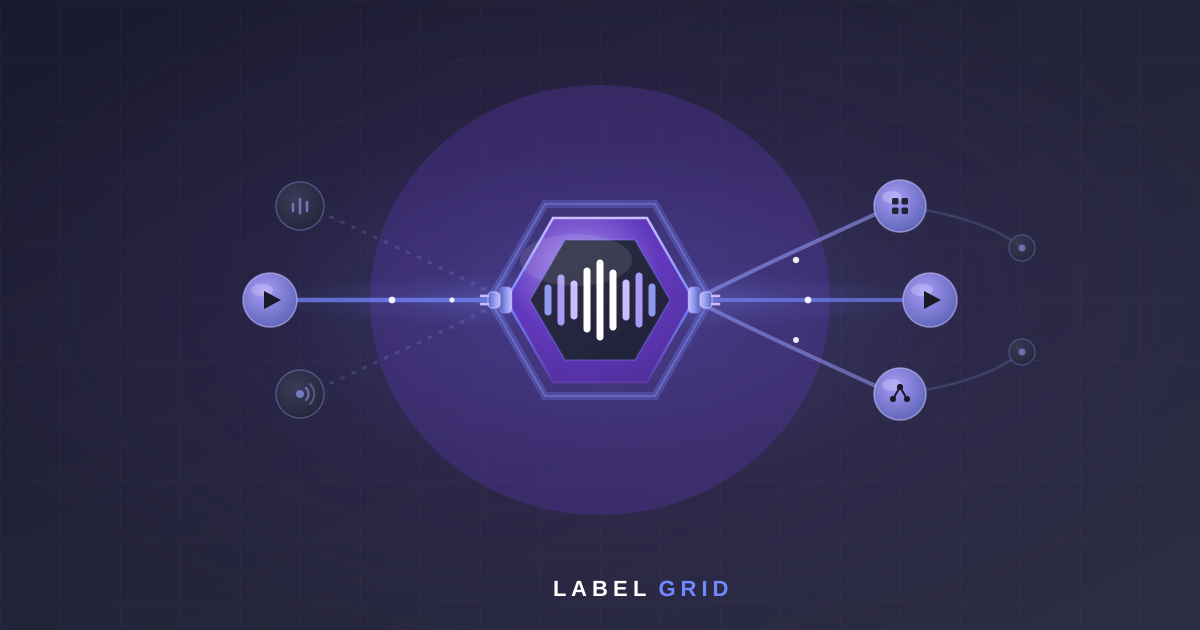
Underneath all of this, the delivery mechanism is the same one that reaches the global majors. A release is packaged and delivered over DDEX rails, the music-industry standard message format that distributors and platforms use to exchange releases and metadata. LabelGrid delivers using DDEX ERN, supporting version 3.8.2 and the 4.3.x family, and the receiving platform ingests from that same feed. KKBOX’s own guidance naming DDEX as an accepted delivery format is a good illustration. The Asian route is not a bespoke pipeline, it is the standard one pointed at a different endpoint.
For the label, that means the work is front-loaded into one clean submission rather than spread across a dozen platform portals. You create the release once, add the identifiers and native-script metadata once, choose the territories and stores, and the distributor fans it out to each active route it holds, including the Asian ones covered here. Delivery status, and any per-platform issues, come back through the same dashboard as everywhere else.
That single pipeline is also what makes Asian reach practical at scale. A label running a large catalog, or a distributor operating its own white-label and API service on top of LabelGrid, can push releases and metadata programmatically instead of one form at a time, and the same label tooling that manages Western distribution, accounting and payouts covers the Asian routes without a separate system. The complexity of the region lives in the routes and the licensing. The label’s side of it stays the ordinary create-and-deliver flow.
The short version is the one at the top. Asia is reachable, but selectively and through a distributor, not as a single global switch. Know which platforms your routes actually cover, get the native-script metadata right the first time, and treat the services you cannot reach directly as exactly that rather than assuming them into a plan.
Frequently Asked Questions
Do I need a separate deal for each Asian country?
No. You do not negotiate a separate contract with each platform yourself. Your distributor holds the delivery relationships, so one release delivered through LabelGrid fans out to every active Asian route it covers, such as the QQ Music ecosystem, NetEase, FLO, AWA, KKBOX and JioSaavn, alongside the global majors. What you cannot do is reach a platform your distributor has no route to. For those, coverage depends on the platform’s own onboarding or a specialist aggregator.
Is Chinese, Japanese or Korean script metadata required?
It is not strictly mandatory to deliver, but native-script metadata is strongly expected and carries real discovery weight in these markets. Chinese, Japanese and Korean title, artist and writer fields, plus time-synced lyrics where you have them, help platforms like KKBOX, the Chinese services and the Korean and Japanese apps match and surface your release. Because corrections on distributor-fed platforms flow back through the distributor rather than a self-serve screen, it is far better to supply correct native-script metadata at delivery than to fix it later.
How do royalties report back from Asian platforms?
Royalties from Asian platforms report back through the same accounting flow as any other store. The platform reports usage and revenue to the distributor, and it appears in your statements alongside your other DSP earnings. Recording revenue and composition revenue stay separate. The platform pays the recording owner, while the underlying composition is cleared and paid through each market’s national collecting society, such as JASRAC or NexTone in Japan, KOMCA in Korea and IPRS in India.
How far ahead should I schedule an Asian release?
Schedule ahead rather than assuming same-day availability. Regional platforms process releases on their own clocks, and several, including KKBOX, ingest through a label platform or a DDEX feed that needs lead time before an on-sale date. Use the same forward scheduling you would for a coordinated global release: set the date, deliver well before it, and leave room for the platform to process and surface the release.
Do these platforms accept every genre?
Delivery to these platforms is not gated by genre the way a curated playlist is, and they carry broad local and international catalogs. What differs by market is editorial and merchandising treatment, which is a discovery question rather than a delivery one. Clean metadata and clear rights matter far more to acceptance than the genre does.
How do takedowns work on Asian platforms?
A takedown routes the same way as the original delivery, in reverse. You request removal through your distributor, and the instruction is sent to each platform through the same distribution channel that delivered the release. Because Asian platforms are distributor-fed rather than self-serve, the removal is handled through that relationship, so allow processing time just as you would for delivery.