
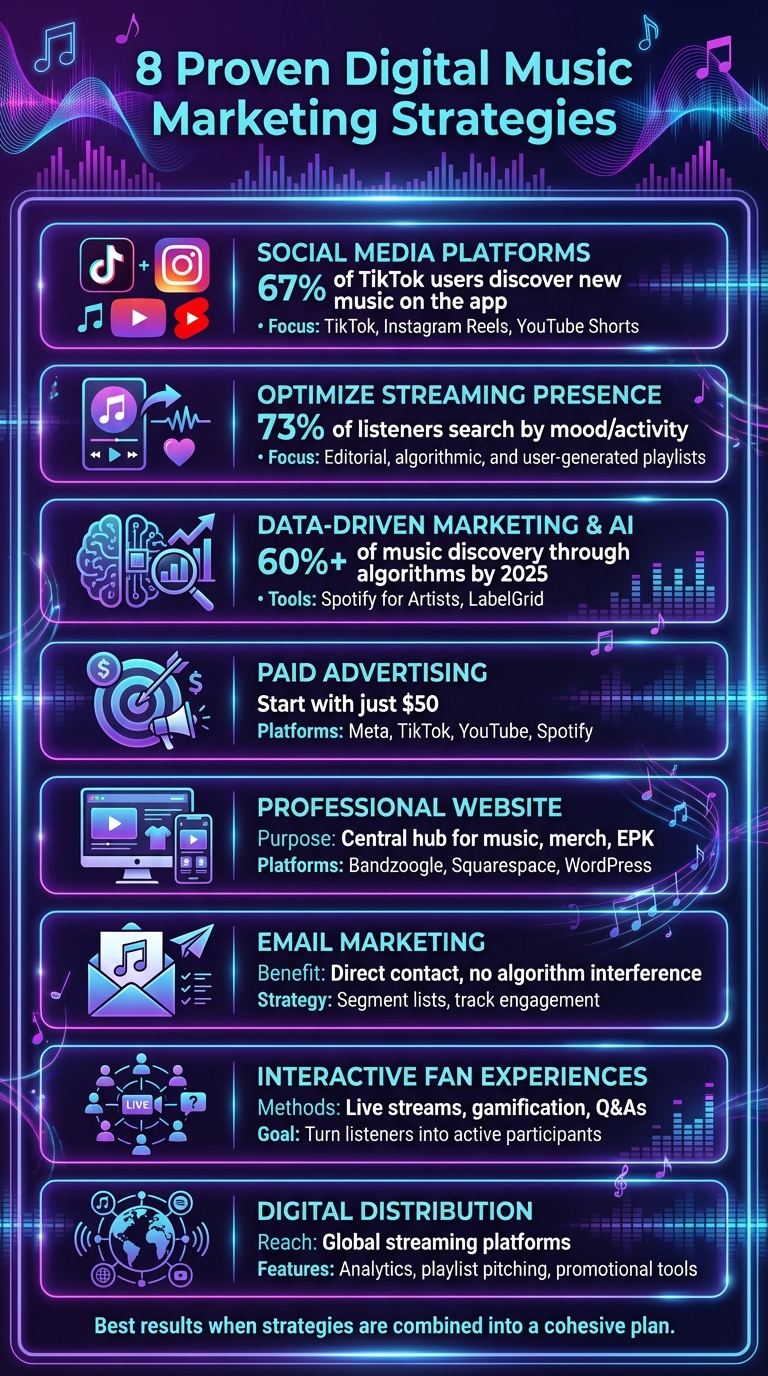
Reaching listeners in today’s fast-moving music industry requires smart strategies tailored to digital platforms. Here’s a quick guide to help you stand out:
- Leverage Social Media: Focus on platforms like TikTok, Instagram Reels, and YouTube Shorts for short-form videos. Collaborate with other artists and use analytics tools to refine your approach.
- Optimize Streaming Profiles: Claim and personalize your artist profiles on Spotify, Apple Music, and others. Pitch to editorial, algorithmic, and user-generated playlists for maximum visibility.
- Use Data and AI Tools: Analyze listener behavior to target the right audience. Tools like Spotify for Artists and LabelGrid can help refine your marketing.
- Run Paid Ads: Start with as little as $50 on platforms like Meta, TikTok, and YouTube. Focus on targeting fans of similar artists and experiment with short-form video ads.
- Build a Website: Create a central hub for your music, merch, and updates. Use platforms like Bandzoogle or Squarespace to design a professional, mobile-friendly site.
- Email Marketing: Maintain direct contact with fans by building an email list. Offer exclusive content and track engagement metrics to strengthen connections.
- Interactive Fan Engagement: Host live streams, gamify fan interactions, and create personal touchpoints to build loyalty.
- Digital Distribution: Use platforms that handle global distribution while offering playlist pitching, analytics, and promotional tools.
These strategies work best when combined into a cohesive plan. Start small, track your results, and grow your audience step by step. Focus on connecting with listeners where they already are, and let your music do the rest.
20 Genius Music Marketing Tips in 12 Minutes
1. Use Social Media Platforms to Promote Your Music
One of the most effective ways to market your music in 2025 is by leveraging social media. These platforms act as direct pipelines to your audience. For example, 67% of TikTok users discover new music on the app, and 1 in 4 users find their favorite new songs there. This makes short-form video content a must-have tool for any artist looking to expand their reach.
Platforms like TikTok, Instagram Reels, and YouTube Shorts dominate music discovery. YouTube, being the second-largest search engine in the world, is a particularly powerful space for music promotion. However, simply posting content isn’t enough – each platform has its own style, and tailoring your posts to fit these nuances is key to standing out.
Building an active and engaged community is far more impactful than amassing thousands of passive followers. When your audience comments, shares, and streams your music, it not only boosts engagement but also influences streaming algorithms. In fact, over 60% of music discovery happens through algorithms, with TikTok alone driving more than 40% of streaming decisions.
Collaborations can also amplify your reach. Partner with other artists, participate in trending challenges, or get involved with niche communities on platforms like Discord or genre-focused subreddits. These efforts can help you cultivate a loyal fanbase.
Lastly, take advantage of analytics tools on platforms like Facebook, Instagram, and Spotify for Artists. These tools can help you track your top-performing posts, determine the best times to post, and understand your audience better, allowing you to fine-tune your strategy for maximum impact.
2. Optimize Your Streaming Presence and Pitch to Playlists
Your artist profile on streaming platforms is a key spot where potential fans decide whether to stick around or move on. Start by claiming your profiles on platforms like Spotify, Apple Music, Amazon Music, YouTube Music, and SoundCloud. Tools like Spotify for Artists and Apple Music for Artists let you personalize your profile with a bio, photos, and your story. Keeping your branding consistent across platforms – like using the same @username – makes it easier for fans to find you. Once your profiles are polished, the next step is pitching your music strategically to playlists.
Playlists have become the modern-day radio, offering a way to get your music in front of millions almost instantly. To get the most out of this, aim for all three types of playlists: editorial (curated by platform teams), algorithmic (like Spotify’s Discover Weekly), and user-generated (created by independent curators and influencers).
For editorial playlists, submit your unreleased track through Spotify for Artists at least seven days before it drops. Be detailed when filling out the metadata – include specifics about the genre, mood, and instrumentation. For user-generated playlists, research curators who align with your style and craft a concise, compelling pitch.
“Most listeners do not browse artist profiles on Spotify to discover new music; they just use different playlists to get exposed to new music by unknown artists.” – One Submit
Steer clear of pay-for-play schemes or fake streams, as they can result in bans or damage your credibility. Instead, focus on authentic engagement. When listeners save your track, add it to their personal playlists, or listen all the way through, Spotify’s algorithm takes notice and shares your music with a broader audience. With 73% of listeners now searching for music based on activity or mood rather than artist or genre, accurate tagging is more important than ever.
3. Apply Data-Driven Marketing and AI Tools
The stats are crystal clear: by 2025, more than 60% of music discovery will happen through algorithm-driven platforms. Simply guessing your audience won’t cut it anymore. You need solid data to understand who’s listening, when they’re tuning in, and what keeps them engaged. Platforms like Spotify for Artists and Apple Music for Artists offer free analytics dashboards that provide insights into listener demographics and engagement metrics. These tools are your starting point for crafting a smarter, more precise marketing strategy.
Data-driven marketing takes targeting to a whole new level. Instead of aiming broadly at “18-24-year-olds who like rock music”, AI tools analyze individual behaviors – like what songs people skip, replay, or save. This lets you target listeners based on their actual habits, not assumptions, and can boost conversion rates by connecting your music to the right audience. These insights help you position your tracks where they’ll have the most impact.
AI tools don’t just stop at basic analytics. They dive deeper, processing huge amounts of data like song preferences, play frequency, search history, and even the times people listen. AI can also analyze the musical elements of your tracks alongside listener behavior, giving you a clear game plan for optimizing releases, creating ads, and refining your content.
Take LabelGrid, for example. It integrates data-driven marketing tools directly into your distribution workflow. From tracking performance metrics to managing royalties and running targeted campaigns, you can do it all from one dashboard. Whether it’s pre-save campaigns, smart links, or gated downloads, having everything in one place simplifies the process of turning insights into action. This streamlined approach shows how combining data and marketing tools can amplify your reach.
Start small. Focus on improving one metric at a time – maybe it’s boosting your save rate or reducing skips in the first 30 seconds of a track. Use the data to test different release strategies, tweak ad creatives, or refine your playlist pitches. Then, double down on what works. Data doesn’t replace creativity; it simply ensures your music finds the people who’ll connect with it the most.
4. Run Paid Ads with Targeted Audience Selection
Paid ads are a powerful way to amplify your digital reach, especially when combined with data-driven insights. While organic growth is essential, paid advertising can give your efforts a noticeable boost. The good news? You don’t need a massive budget to get started – just $50 can deliver measurable results. Focus your spending on platforms where your audience spends the most time, like Meta (Instagram and Facebook), TikTok, YouTube, or Spotify.
What makes paid ads so effective is their ability to target specific behaviors and interests, rather than just broad demographics. For example, on Facebook and Instagram, you can reach users who follow artists similar to you, attend music festivals, or engage with particular genres. On Spotify, you can connect directly with listeners through curated playlists that match your style, ensuring your ads reach people who are already inclined to enjoy your music.
To make your ads stand out, create content that feels organic to the platform. Use short videos, lyric snippets, live performance clips, or even content created by fans. A 15-30 second video that grabs attention in the first few seconds often performs better than a generic post. Try experimenting with different ad formats – like video, carousel, or stories – and use A/B testing to fine-tune your visuals, copy, and call-to-action.
“You don’t need a massive budget to make digital advertising work – but you do need a clear objective and a willingness to test and learn.” – Christopher Wares, Assistant Chair of Music Business/Management at Berklee
Retargeting is another smart strategy to maximize your efforts. Tools like Facebook Pixel and Google Ads let you reconnect with warm leads – people who have visited your website or interacted with your content. Just remember, paid ads are most effective when they work alongside your organic strategies, forming a balanced approach to growing your audience.
5. Build a Professional Music Website
Your website is the heart of your music’s online presence. It’s your personal space to connect with fans, showcase your work, sell merchandise, promote your shows, and grow your email list. Unlike social media, where distractions are everywhere, your website offers a focused environment where fans can fully engage with your music.
Think of it as your digital headquarters. A well-designed site should include an EPK (Electronic Press Kit) with your bio, press quotes, links to your releases, high-resolution images, and videos. Don’t forget to link your social media accounts, and make sure the design is mobile-friendly – most fans will likely visit from their phones.
“Your website is your central hub – it’s the one place where you control the experience. Social platforms are built to keep people scrolling, and it’s easy for visitors to get pulled into DMs, notifications, or unrelated content. Your website offers a distraction-free space to showcase your music, sell merch, promote shows, and collect emails for your mailing list.” – Christopher Wares, Assistant Chair of Music Business/Management, Berklee
Creating a professional website is easier than you might think – no coding required. Platforms like Bandzoogle, Squarespace, and WordPress provide customizable templates that help you design a site that fits your brand. Consistency is key: align your website’s look with your social media profiles and album artwork. Add a clear mailing list sign-up option (offering something like a free track download can be a great incentive) to encourage fans to join.
Your website also gives you control over merchandise sales, inventory, and revenue. Regularly update it with fresh content, such as new releases, tour dates, or media appearances, to keep fans engaged and feeling like they’re part of your journey. A polished, up-to-date website not only connects with fans but also shows industry professionals, collaborators, and press contacts that you’re serious about your career. It’s the foundation for building direct communication with your audience and sets the stage for effective email marketing in the next step.
6. Connect with Fans Through Email Marketing
Email marketing is a powerful way to build a direct connection with your audience. Unlike social media, where algorithms decide who sees your posts, email ensures your messages land directly in the inboxes of fans who chose to hear from you. It’s your chance to share updates like new releases, tour dates, exclusive content, or personal stories – without competing for attention in a crowded feed.
Start by making it simple for fans to join your mailing list. Add a sign-up form to your website and offer a small incentive, like a free track download, an exclusive demo, or behind-the-scenes content. Keep an eye on sign-up trends to see which events or releases drive the most interest. Once your list grows, segment it to send more personalized messages. For instance, fans in specific cities can get tour updates, while your most loyal listeners might receive early access to new music.
When it comes to crafting emails, keep them personal and engaging. Share behind-the-scenes moments, song drafts, or even updates about your life – things that help fans feel closer to your creative process. Look at successful newsletters for inspiration, and don’t forget to follow up with thank-you messages after shows or invite fans to upcoming performances. These small gestures can make a big difference in strengthening connections.
To fine-tune your approach, track key metrics like open rates and click-through rates. These numbers can reveal what content resonates most with your audience. Identify your most engaged fans and nurture them – they could become your core group of superfans. Automating your emails can also help you stay consistent without feeling overwhelmed.
Email marketing works hand-in-hand with your digital presence, boosting engagement and expanding your reach. Fans who forward your newsletters to friends or industry contacts can help grow your audience organically. Beyond that, a dedicated email list can provide financial support through music and merchandise sales, and the emotional encouragement and word-of-mouth buzz that can help take your career to the next level.
7. Create Interactive Fan Experiences
Interactive content has a way of turning passive listeners into active participants. When fans feel like they’re a part of your journey, they’re more likely to share your music, show up at your concerts, and stick with you for the long haul. As Alex Tarlescu, Co-founder of Get More Streams, explains:
“Interactive content is the digital handholding that fans dream about”.
One way to build these connections is through live streaming. Take country-rock artist John Stevens Jr., for example. He hosts weekly live streams where he chats with fans, takes song requests, and even sells merchandise. These sessions generate around 500 comments each time. By creating a space where fans feel heard and appreciated, he’s turning casual listeners into loyal supporters.
Adding a personal touch can make a huge difference, too. Artist H’Atina found success by sending out weekly affirmation videos to her fans through email and social media. These videos sparked hundreds of likes and comments, keeping her audience engaged while also streamlining her promotional efforts. Simple gestures like addressing fans by name or tailoring content to their preferences can go a long way in strengthening these relationships.
Gamification is another way to ramp up fan engagement. Features like points, badges, and leaderboards make interactions fun and rewarding, encouraging fans to stay connected. Platforms like Patreon offer exclusive content that helps build a tight-knit community, while social media tools like polls, Q&As, and challenges spark conversations and keep fans involved.
Fans who feel engaged often become your biggest advocates, spreading the word about your music through social sharing and recommendations. By focusing on meaningful interactive experiences, you’re not just gaining fans – you’re building a community that grows alongside you. These strategies also create a strong foundation for boosting your other direct marketing efforts.
8. Use Digital Distribution and Marketing Platforms
Taking your music to a global audience starts with getting it onto major streaming platforms like Spotify, Apple Music, Amazon Music, and YouTube Music. These platforms make your music accessible to listeners worldwide. Digital distribution services take care of the technical heavy lifting, delivering your tracks to these platforms while offering tools to manage your catalog, track earnings, and promote your releases.
When choosing a distribution platform, ensure it allows you to keep full ownership of your music copyrights and offers flexible, no-strings-attached contracts. Key features to look for include easy upload processes, detailed analytics, fan demographic insights, playlist tracking, and profile management. These tools help you better understand your audience and refine your marketing strategies.
Playlist pitching is another essential feature. Make sure your platform supports submitting tracks for editorial playlist consideration. To increase your chances, pitch your music at least three to four weeks before release and accurately tag your genre and subgenres. Be cautious of “pay-for-play” schemes, as they can lead to bans or removal from platforms.
Many distribution platforms also offer promotional tools to boost your visibility. These can include SmartLinks, pre-save campaigns, and even access to marketing experts. Some platforms go a step further with AI-driven advertising tools like Spotify’s Marquee or Amazon Music DSP. These tools target listeners based on their habits and can achieve conversion rates up to three times higher than traditional advertising methods.
Take the time to research and compare platforms, considering their fees, features, and support options. Choose a service that not only handles distribution but also provides the analytics and promotional tools you need to grow your fanbase and revenue. When combined with your social media and email campaigns, these platforms can significantly amplify your reach and impact.
Comparison Table
Here’s a quick reference to help you weigh the differences between playlist strategies and paid advertising formats, so you can align your marketing approach with your goals and budget. Each option serves distinct purposes depending on where you are in your music career.
Playlist Types
- Editorial Playlists
These are curated by streaming platforms’ internal teams and often boast the largest followings, making them a powerful tool for gaining exposure. To improve your chances of being featured, submit your music through your artist dashboard at least three to four weeks before release. - Algorithmic Playlists
Playlists like Discover Weekly are personalized using AI to reflect individual listening habits. Increasing your streaming numbers, saves, and repeat plays can boost your chances of being included in these playlists. - User-Generated Playlists
Created by independent curators or individual users, these playlists can foster meaningful engagement, especially for newer artists. To get featured, identify niche curators and pitch your music in a concise, compelling way.
Paid Advertising Formats
- Short-Form Video Ads
Videos featuring lyric snippets, live performances, or behind-the-scenes moments tend to perform well when they resemble organic content. These ads should be tailored for platforms like Instagram, Facebook, TikTok, and YouTube. As Christopher Wares, Assistant Chair of Music Business/Management at Berklee, puts it: “The best-performing ads often look and feel like organic content – short-form videos, lyric snippets, or live clips. Make sure they’re optimized for the platform where they’ll appear”. - Targeting Warm Audiences
Focus your ads on audiences who have already interacted with your content for better conversion rates.
Choosing the Right Strategy
Your approach should reflect your career stage:
- If you’re just starting out, prioritize user-generated playlists and organic social media content.
- As your audience grows, algorithmic playlists and targeted paid ads can help amplify your reach.
- Editorial playlists work best when you already have a solid base of engagement.
Use this table to guide your decisions as you tailor your marketing strategy to your current growth phase.
Conclusion
The eight strategies we’ve discussed are most effective when they work together as a unified system. Social media boosts awareness, playlists increase streams, data guides your decisions, paid ads expand your reach, your website serves as your brand’s home base, email keeps fans engaged, interactive experiences strengthen connections, and digital distribution platforms ensure your music reaches a broad audience. Together, these tools form a well-rounded marketing framework that consistently shares your story and connects with your audience where they already are.
In this ever-changing digital world, your marketing approach needs to remain flexible. What works today might need adjustments tomorrow, so it’s important to regularly analyze your data. Keep an eye on emerging platforms and tools. Dive into the details – track your most popular songs, identify where your fans are located, figure out the best times to post, and refine email subject lines that resonate. This kind of ongoing evaluation helps you stay in tune with your audience and adapt your strategy as needed.
Your marketing plan should always reflect your personal brand, career goals, and where you are in your journey. If you’re just starting out, focus on organic social media content and user-driven playlists. As you grow, you can start exploring algorithmic playlists and targeted advertising. Keep in mind that marketing is a marathon, not a sprint – it’s about building a consistent narrative over time, not relying on one-off promotions.
Above all, focus on being genuine. Your audience wants to connect with the real you, not a carefully curated persona. This authentic approach ties back to the interconnected strategies we’ve discussed throughout.
The most effective campaigns maintain consistent branding across all platforms. Build your strategy around your audience and use tactics that speak directly to them. When your marketing aligns with your authentic self, it strengthens the foundation we’ve explored in this guide.
FAQs
What’s the best way to pitch my music to playlists?
To get your music noticed by playlists, the first step is to polish your artist profile on platforms like Spotify. Use a high-resolution profile picture, write an engaging bio that tells your story, and connect your social media accounts. This makes your profile more appealing and professional.
It’s also crucial to submit your music early – ideally at least 7 days before the release date. Be sure to include accurate metadata, such as track titles, artist names, genres, and moods. This information helps curators quickly understand your music and its potential fit for their playlists.
When pitching, focus on creating a brief, personal message that shares the essence of your song. Highlight its mood, the story behind it, and why it’s a perfect match for the playlist. If you’ve already built some momentum – like generating pre-saves or creating buzz on social media – that can make your pitch even stronger.
How can AI tools be effectively used in digital music marketing?
AI tools have the potential to transform music marketing when applied with care. They can streamline the creative process by assisting in crafting and fine-tuning content like songs, lyrics, and promotional materials. Beyond creativity, AI can analyze audience data to pinpoint the ideal timing for releases and fine-tune marketing campaigns to connect with the right listeners.
However, staying genuine and maintaining trust with your audience is crucial. Using AI ethically and transparently ensures that your marketing efforts align with your artistic vision while respecting your fans.
How can I start building an email list to connect with my music fans?
To grow your email list, start by setting up a professional website that represents your brand and makes it easy for fans to subscribe. Add features like a sign-up form or a pop-up that grabs attention. Then, take advantage of social media. Share behind-the-scenes moments, interact with your followers, and offer exclusive perks – like early access to new music, discounts on merch, or free downloads – to encourage them to join.
Engaging with your community is just as important. Reply to fans, share their content, and keep the conversation going. Consistently releasing new music or updates also keeps your audience excited and connected. The goal is to build real relationships while offering something valuable that makes fans look forward to hearing from you.