Today we are releasing the official LabelGrid MCP server: a way to connect your own AI assistant to your LabelGrid account and run your music distribution by asking for what you want. Point Claude Desktop, Claude Code, Cursor, or any other Model Context Protocol client at your account, and you can draft a release, ask why one is stuck in review, pull last quarter’s royalties, or check which stores a single has gone live on, all in plain language. It is first-party, it is open source under the MIT license, and it is live now on npm as @labelgrid/mcp.
If you have ever wished you could talk to your distribution backend the way you talk to a colleague, this is that. Below is what the Model Context Protocol actually is, everything the server can do, how to connect it in about a minute, and the part we care about most: the safety model that keeps an AI assistant firmly inside the guardrails your account already has.
What the Model Context Protocol is, in plain terms
The Model Context Protocol, usually shortened to MCP, is an open standard for connecting AI assistants to outside tools and data. On its own, an assistant can only reason and write text. MCP gives it a set of concrete actions it can call, published by a server, so it can go and do real work against a real system instead of describing what you might do. An MCP server, in other words, is the bridge between the assistant and a service.
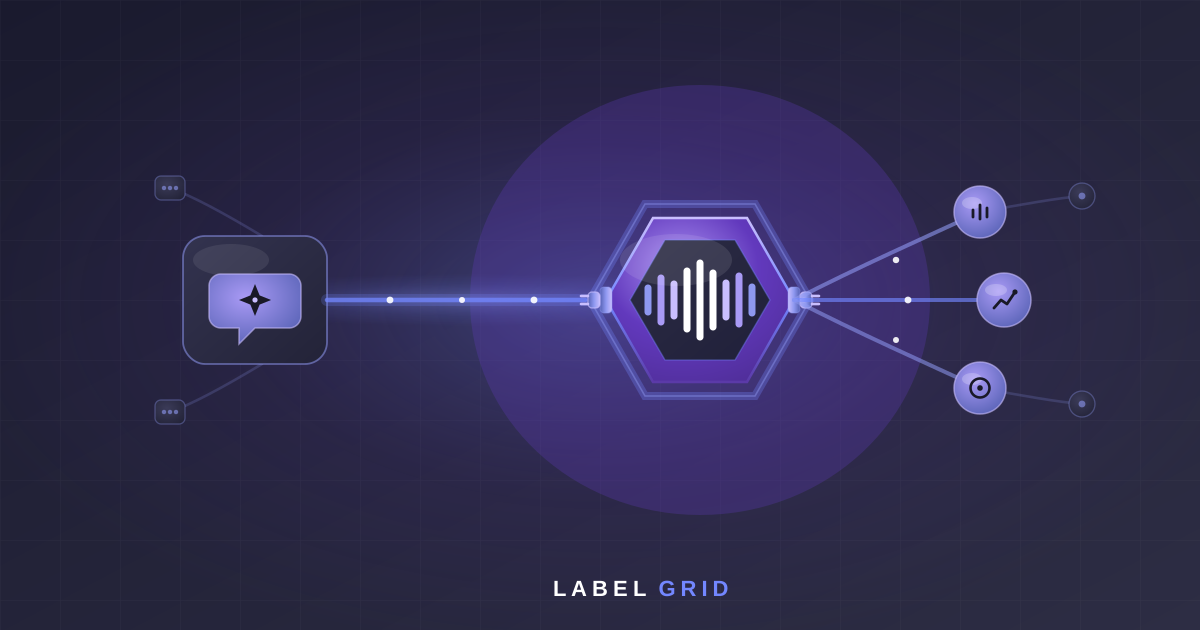
The LabelGrid MCP server is that bridge for your distribution account. It exposes LabelGrid’s operations to any assistant that supports the protocol, and it is built as a thin, typed wrapper over the same public API developers already build against. Nothing new sits behind it and no new rules are invented. When your assistant asks the server to create a release, the server calls the LabelGrid public API, and the API validates the request exactly as it would for any other client. You can read the protocol specification at modelcontextprotocol.io.
What the server can do
The server’s tools are grouped into toolsets by area, and together they reach most of what you do in the dashboard. Rather than list every tool, here is the shape of it, area by area, with the kind of request each one answers.
- Identity and account. “Who am I connected as, and which labels can I work with?” The assistant confirms the account and scope before it touches anything.
- Reference data. “List the genres and languages I can set on a release,” so the values you use are the ones the platform actually accepts.
- Catalog. Create and manage labels, artists, writers and publishers: “Add a new artist called Neon Harbor and set me as the writer.”
- Releases and tracks. “Draft a twelve-track album under my main label and set the release date to next Friday.” The draft is built for you to review, nothing is sent.
- Review and quality. “Validate this release and tell me what is blocking it from passing review,” and the assistant reads the open issues and reports what to fix. It can also read the optional Stream Radar early-warning flags, so you can ask it whether anything unusual has been spotted on your streams.
- Analytics. “Show streams for my latest single by store this week,” broken down the way you asked, per store and per period.
- Accounting and royalties. “Pull last quarter’s royalty statement and break it down by label,” with the splits applied the way you asked.
- Delivery status. “Which stores has the single gone live on, and is anything still pending?”
- Webhooks. “Add a webhook that notifies my server whenever a delivery completes,” so your own systems stay in sync.
And, when you turn it on, distribution. The server can submit a release for distribution, take one down, and upload finished audio and artwork — but because finished files are immutable and a submission goes out into the world, those actions sit behind an explicit gate we will come back to in a moment. Smart-link landing pages are covered too, so a request like “spin up a landing page for the new single” has a home. The point of the toolsets is that the natural-language layer is not a demo skin over a couple of endpoints; it reaches the real work of running a catalog.
Sixty-second setup: add one line, your AI does the rest
The server runs through npx, so there is nothing to download and nothing to keep updated. You need Node.js 20 or newer, and you add a single entry to your MCP client’s configuration:
{
  "mcpServers": {
    "labelgrid": {
      "command": "npx",
      "args": ["-y", "@labelgrid/mcp"],
      "env": {
        "LABELGRID_API_TOKEN": "YOUR_API_TOKEN"
      }
    }
  }
}
Here is the nice part. If you start the server without a token, it does not fail with an error; it enters a guided setup mode and your assistant walks you through connecting your account, one step at a time. So the honest version of the install is: add one line, and your AI handles the rest. When you are ready, generate a token under Profile then API Tokens in your dashboard, drop it into the config, and you are working your catalog in natural language.
Connect your AI assistant to LabelGrid
Install the official open-source MCP server and run releases, analytics and royalties in plain language.
Explore the MCP serverThe safety model: three tiers, fail-closed
Handing an AI assistant the keys to a distribution account is only a good idea if the keys are shaped carefully. This is where we spent the most design effort, so it is worth walking through. The server groups every action into three permission tiers, and the whole thing is fail-closed: if a tier is not enabled, its actions simply are not available.
Reads are always on. Looking up releases, review issues, analytics, royalty statements and delivery status carries no risk of changing anything, so your assistant can answer questions from the first connection. Safe writes are on by default but you stay in control of them: drafting releases and tracks, editing metadata, managing labels, artists, writers and publishers, setting up webhooks, and building landing pages all fall here. You can switch these off, or force the entire connection read-only, whenever you want.
Consequential actions are the third tier, and they are off by default. Distribution submission, takedowns, and immutable audio and artwork uploads stay disabled until you turn them on deliberately. Turning them on is not a single toggle you flip by accident: it takes an explicit opt-in plus a typed acknowledgment. Before any AI-driven submission or takedown can run, you confirm with the exact phrase “I accept responsibility for AI-driven distribution actions.” That sentence is doing real work; it makes the highest-impact actions a conscious choice, not a default.
Two things sit underneath all three tiers. First, every rule and validation runs on LabelGrid’s servers, so the AI can never bypass the protections on your account. The same checks that catch a bad ISRC or a missing field in the dashboard catch it here, because it is the same API doing the checking. Second, distribution submissions still count against your weekly release limits, exactly as they do when you submit by hand. The assistant is a faster way to drive the platform, not a way around its rules.
Open source, and who gets it
The server is first-party and open source under the MIT license. The code lives at github.com/labelgrid/labelgrid-mcp and the package is on npm as @labelgrid/mcp, so you can read every line, fork it, wire it into your own workflow, or open an issue if something is off. Building it in the open felt right for a tool that sits this close to your catalog: you should be able to see exactly what it does before you point it at your account.
Because the server talks to the LabelGrid public API, it is available on LabelGrid’s API plans. If you already have API access, you can generate a token and connect today. If you are coming to the API for the first time, the API overview in the help center is the place to start, and you can compare the options on the pricing page. Developers who want the underlying REST and sandbox story can read the distribution API and developer pages.
That is the launch. One line in your config, a guided setup that connects your account, and a permission model built so an AI assistant can help without ever stepping outside your account’s rules. We are keen to see what people build on it, so if you try it, tell us what you make it do.
Frequently Asked Questions
What is the LabelGrid MCP server?
The LabelGrid MCP server is the official, open-source connector that links an AI assistant to your LabelGrid account through the Model Context Protocol. Its tools span your whole account, so you can create releases, check review issues, pull analytics and royalty statements, manage webhooks, and check delivery status by asking in plain language. Under the hood it is a thin, typed wrapper over the LabelGrid public API, which means the same validation that runs in the dashboard runs here too.
What is the Model Context Protocol?
The Model Context Protocol, or MCP, is an open standard for connecting AI assistants to external tools and data. An MCP server exposes a set of actions an AI client can call, so an assistant like Claude or Cursor can operate a service directly instead of guessing. LabelGrid publishes an MCP server so your assistant can work your distribution account, and you can read the full specification at modelcontextprotocol.io.
Which AI assistants can I use with it?
Any client that speaks the Model Context Protocol works, including Claude Desktop, Claude Code, and Cursor. You add one entry to the client configuration and the server takes care of the rest. If you start it without a token, it enters a guided setup mode and your assistant walks you through connecting your account step by step.
Can the AI distribute or take down my releases on its own?
No. Distribution submissions, takedowns, and immutable audio and artwork uploads are off by default and stay disabled until you explicitly opt in and type an acknowledgment confirming you accept responsibility for AI-driven distribution actions. Reads and safe draft edits are available without that step, every action is validated on LabelGrid servers, and distribution submissions still count against your weekly release limits.
Do I need an API plan, and how do I get started?
Yes. The MCP server connects through the LabelGrid public API, which is part of LabelGrid API plans. If you already have API access, generate a token under Profile then API Tokens in your dashboard and connect today. If you are new to the API, start with the API overview in the help center and the pricing page to choose a plan.