A music distribution API is a programmatic interface that lets software send releases to streaming platforms automatically, without manual uploads. Instead of filling in forms for each track, your application calls the API to create releases, attach audio and artwork, set metadata, schedule delivery, and pull back analytics and royalty data. It turns distribution into something your code can drive.
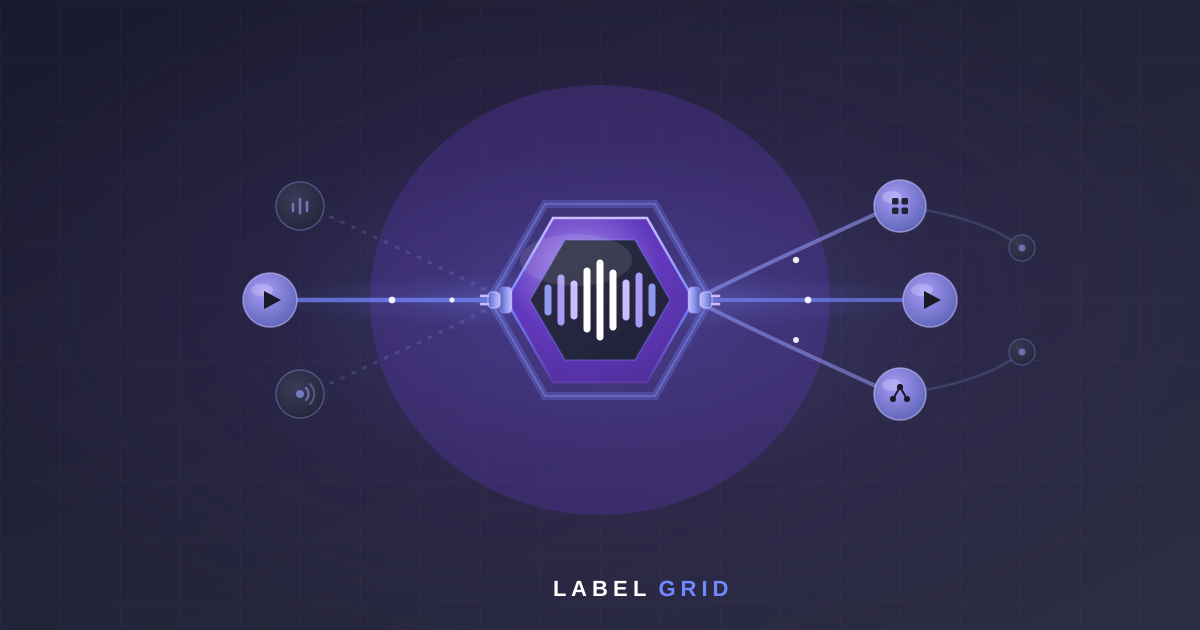
APIs (application programming interfaces) are how two systems talk to each other. A music distribution API exposes a distributor’s delivery pipeline (DSP connections, encoding, DDEX feed generation, royalty processing) as endpoints your software can call. For anyone moving real volume, that’s the difference between a person clicking “upload” and a system that ingests hundreds of releases on its own.
This guide explains how a distribution API works, who needs one, what build-versus-buy looks like, and how to evaluate providers, including where LabelGrid fits.
How does a music distribution API work?
You authenticate, then make HTTP requests to create and manage releases. A typical flow looks like this:
- Authenticate with an API key or token.
- Create a release and attach tracks, audio files, artwork, and metadata (titles, ISRCs, artists, genres, territories).
- Validate. The API checks metadata and audio against DSP and DDEX requirements before delivery.
- Deliver to chosen DSPs, optionally on a schedule.
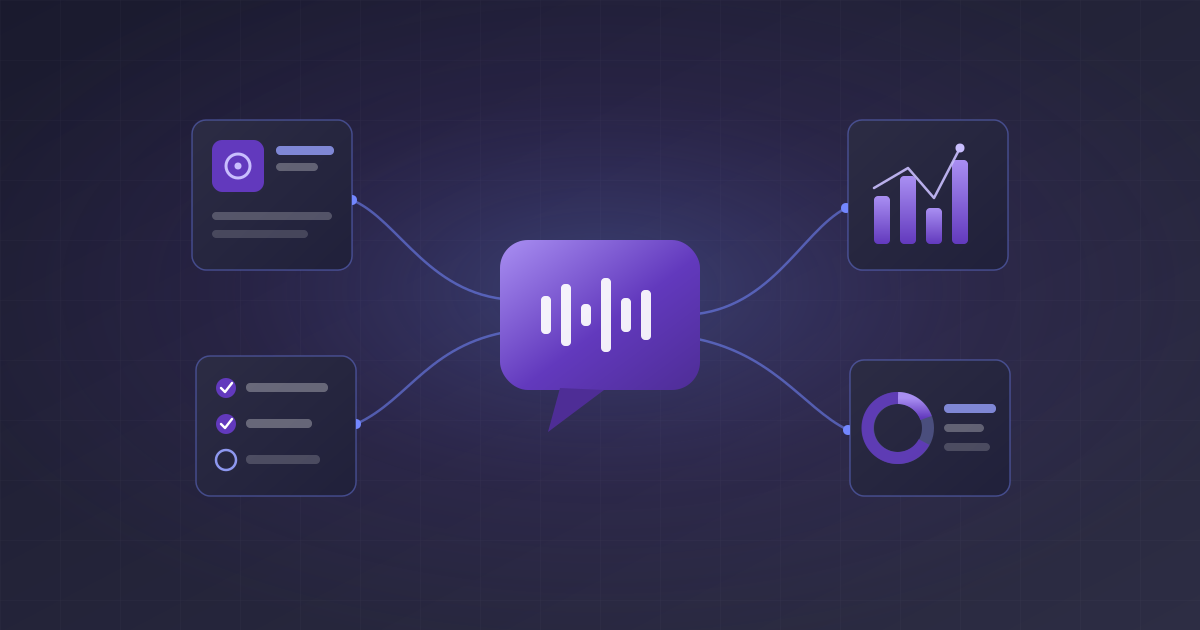
- Retrieve delivery status, streaming analytics, and royalty reports back through the API.
Underneath, the provider generates the DDEX feeds (ERN 3.8.2 and 4.3 are the industry standard), transcodes audio to each DSP’s spec, and pushes the delivery. Good APIs include a sandbox environment so you can build and test the full flow against fake data before touching production. Webhooks notify your system when a delivery completes or a status changes, so you don’t have to poll.
The reason this matters at scale: roughly 99,000 new tracks were delivered to streaming services every day in 2024 (Luminate 2024 Year-End Report). No one is processing that volume by hand. LabelGrid’s REST API exposes exactly this flow (release creation, metadata, delivery, analytics, and royalty endpoints) with a sandbox and public docs at api.labelgrid.com/docs.
Who needs a music distribution API?
An API is overkill if you release a handful of singles a year. It becomes essential when distribution is high-volume or part of a product. The main users:
- Distributors and white-label operators who run a distribution business and need to ingest releases programmatically rather than upload them one by one.
- Labels with large or fast-growing catalogs where manual entry is a bottleneck and consistency matters across hundreds of releases.
- Software platforms such as label-management tools, creator apps, and rights administrators that want to embed distribution inside their own product.
- Aggregators and rights administrators automating delivery on behalf of many clients.
The common thread is automation. The streaming market is now huge: 69.6% of global recorded music revenue, with 837 million paid subscribers (IFPI Global Music Report 2026). The operations that win are the ones that can deliver and account for music without a human in every loop.
Build vs buy: should you build your own DSP connections?
You can negotiate direct deals with every DSP and build your own delivery pipeline, or you can call a distribution API that already has those connections. Here’s the trade-off.
| Factor | Build your own DSP pipeline | Use a distribution API |
|---|---|---|
| DSP relationships | You negotiate each one | Already in place |
| DDEX feed generation | You build and maintain it | Handled by the provider |
| Time to launch | Months to years | Days to weeks |
| Audio encoding per DSP | Your responsibility | Built in |
| Royalty reconciliation | You build accounting | Provided via API |
| Ongoing maintenance | You track every DSP spec change | Provider keeps feeds current |
| Best fit | Major-scale operations with negotiating power | Almost everyone else |
For the vast majority of operations, buying through an API is the rational choice. Building direct DSP infrastructure only pays off at a scale where you have the bargaining power to negotiate and the engineering to maintain it.
Test the API in a sandbox
Create a release, attach files, and trigger a delivery in code before you write a line of production integration.
Start in the sandboxWhat should you look for in a music distribution API?
Use this checklist when comparing providers.
| Criterion | What good looks like |
|---|---|
| Sandbox environment | A full test environment with fake data. Its absence signals immature tooling. |
| Public documentation | Open, current docs you can read before signing up, not a PDF behind a sales call. |
| Webhooks | Event notifications for delivery and status changes, so you don’t poll. |
| DDEX support | ERN 3.8.2 and 4.3 feed generation, maintained as DSP specs evolve. |
| Analytics & royalty endpoints | Pull streams, revenue, and royalty data back programmatically, not just push releases. |
| Transparent pricing | Published rates and royalty caps so you can model unit economics. |
| Self-service signup | You can start testing without waiting on an enterprise sales process. |
How to choose and integrate a distribution API: a step-by-step path
- Map your volume and use case. How many releases per month, how many labels, and is distribution your product or just a feature? This sets your requirements.
- Shortlist on API maturity. Sandbox, public docs, webhooks, and analytics/royalty endpoints are the differentiators. Our comparison of music distribution APIs covers the field.
- Read the docs and test in the sandbox. Build a small integration that creates a release and pulls its status. This reveals real API quality faster than any sales deck.
- Check pricing and royalty caps. Model your costs at current and projected volume, since some plans cap monthly royalties processed.
- Integrate and validate. Wire up release creation, delivery, webhooks, and royalty reporting. Confirm metadata validation catches errors before delivery.
- Go live and monitor. Watch delivery status and reconcile royalty data against your own accounting.
LabelGrid fits this path with an open REST API, sandbox, public docs, and DDEX 3.8.2 / 4.3.2 delivery. API plans publish their pricing and monthly royalty caps up front, with self-service signup, so you can start in the sandbox today. Automated royalty splits and multi-label management come built in, and as a Spotify Preferred Provider and Merlin Network member it delivers to all major DSPs.
Music distribution API: the bottom line
A music distribution API replaces manual uploads with code-driven delivery: create releases, validate metadata, deliver to DSPs, and pull analytics and royalties, all programmatically. It’s essential for distributors, large catalogs, and software platforms; unnecessary for occasional releases. Build-versus-buy almost always favors buying through a mature API, and the providers worth shortlisting offer a sandbox, public docs, webhooks, and transparent pricing. To try it hands-on, LabelGrid’s API has a sandbox and self-service signup so you can build before you commit.
Frequently Asked Questions
What is a music distribution API used for?
It lets software create and deliver music releases to streaming platforms automatically. You call API endpoints to set up releases, attach audio and metadata, schedule delivery to DSPs, and retrieve analytics and royalty data, instead of uploading each release by hand.
Do I need an API to distribute music?
No. If you release a few tracks a year, a standard distributor’s upload interface is simpler and cheaper. An API matters when you’re distributing at volume or building distribution into your own product, where manual uploads become a bottleneck.
What is a sandbox environment in a distribution API?
A sandbox is a test environment that mirrors the live API but uses fake data, so you can build and verify your integration without sending real releases to DSPs. A provider that lacks a sandbox usually has less mature API tooling. LabelGrid includes a sandbox with its API.
Should I build my own DSP connections or use a distribution API?
For almost every operation, an API is the better choice. The provider already holds the DSP relationships, generates DDEX feeds, and handles encoding. Building your own pipeline only pays off at major scale, where you have the bargaining power to negotiate deals and the engineering to maintain them as DSP specs change.
Does a music distribution API handle royalties?
Mature APIs expose royalty and analytics endpoints, so you can pull streams, revenue, and royalty reports programmatically, not just push releases. LabelGrid’s API includes royalty reporting and automated splits, so your software can reconcile accounting without manual exports.
What standards do distribution APIs use?
DDEX (Digital Data Exchange) is the metadata standard for delivering music to DSPs, with ERN 3.8.2 and 4.3 the common versions. A good API generates compliant DDEX feeds and keeps them current as DSP requirements change. LabelGrid supports DDEX 3.8.2 and 4.3.2.