Artists and labels in India reach a global audience the same way anyone else does, through a distributor that delivers each release to Spotify, Apple Music, Amazon Music, YouTube Music, Deezer, TIDAL and the other major streaming services worldwide, over DDEX for most of them and a platform-specific package format where a store requires one, Apple among them. What makes India different in 2026 is what happened at home. Between January 2024 and April 2025 three streaming services ceased operations in India: ByteDance pulled Resso, Airtel shut Wynk Music down and steered its subscribers toward Apple Music, and Hungama closed its music service. That leaves JioSaavn and Gaana as the major domestic platforms still standing, in a market where the global services now lead listening. So the honest answer for an Indian release is often two routes at once: an international distributor for global reach, where LabelGrid delivers to JioSaavn among the India-facing services, and a separate arrangement for anything a distributor does not cover, caller tunes included.
That mix, a home market that just consolidated hard and a global market reached through the usual rails, is what makes releasing from India a little different from releasing from London or Los Angeles. This guide walks through both sides: which platforms actually matter in India after the shake-out, the two distribution routes and when you need both, what changes in practice when you release from India, from Devanagari and other Indic-script metadata to rights, caller tunes and how money finds its way back, and a checklist for choosing an international distributor without guessing.
It also draws the honest line where it belongs. LabelGrid delivers to JioSaavn and to the global majors; it does not deliver to Gaana or to the operator caller-tune channels, and this guide says so plainly rather than implying reach that is not there. If you are coming at this from the other direction, delivering catalog into Asia from outside the region, our companion guide on reaching Asian DSPs covers that. And if you run a label outside the United States more generally, the wider mechanics of rights, payouts and territory live in our guide to international distribution for non-US labels. This one is about releasing from India specifically.
How Indian labels deliver to Spotify, JioSaavn and Gaana
Through a distributor, not by uploading to each service. The label prepares the release once, with audio, artwork, an ISRC for each track, a UPC for the release, and the language and script tagged accurately, and the distributor delivers it to every store it covers. Spotify and JioSaavn both receive music this way. JioSaavn takes no direct artist uploads; its ArtistOne portal is for claiming a profile and reading analytics, not for sending audio.
Gaana is the one to plan separately. LabelGrid does not deliver to Gaana, so a label that needs it adds a provider that does. Through LabelGrid, one upload reaches Spotify and JioSaavn together with the other global majors, with the same ISRC and UPC everywhere.
India’s Market After the Shake-Out
India is a streaming market of enormous reach and thin margins. An EY and FICCI report published in March 2026 counted 178 million people streaming music in India in 2025, of whom only about 8% paid for a subscription. The paid base is growing fast, up 37% year on year to 14.4 million subscriptions, but the great majority of listeners do not pay for a subscription. Huge audiences, low per-listener revenue. That shape explains a lot of what happened next.
What happened next was consolidation. Gaana closed its free tier and went subscription-only in September 2022 after failing to raise new investment. ByteDance withdrew Resso from India in January 2024. Airtel announced in August 2024 that it was shutting Wynk Music and, under a new partnership with Apple, steering its premium users toward Apple Music. Hungama’s music service followed on 15 April 2025. Three exits from the Indian market inside eighteen months.
Who leads now? A 2026 EY-IMI survey of more than 15,000 smartphone users found YouTube used for music by 32% of respondents and Spotify by 31%, with Amazon Music at 17%, JioSaavn at 16%, Gaana at 11% and Apple Music at 8%. Those are usage figures rather than revenue shares, and listeners overlap across services. The ordering still tells the story. The global platforms lead Indian listening, and JioSaavn is the domestic service with real weight. Your home audience in India now sits mostly on the same platforms as your global one, with JioSaavn as the significant domestic addition and the operator caller-tune channels as a separate, operator-sold surface that remains prominent in India.
In India the two-path question exists, it is just smaller: the global half of a release reaches the services Indians use most, and the domestic half comes down to JioSaavn, Gaana and the telco channels. Getting clear on which of those your distributor can reach, and which it cannot, is where the real decisions live.
The Two Routes: Indian Platforms and Global Reach
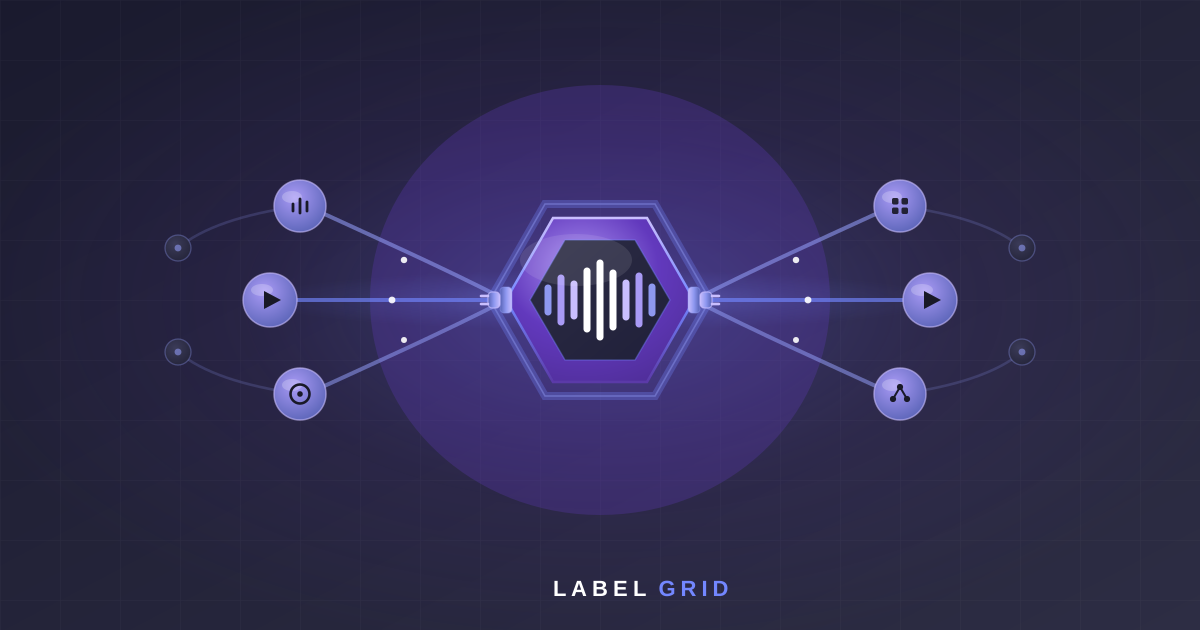
For global reach, you use an international distributor. You create the release once, add your identifiers and metadata, choose your territories and stores, and the distributor delivers it to every service it covers, in whichever format each store takes. LabelGrid works this way for the global majors, and it delivers to JioSaavn among the India-facing services, so a single release reaches Spotify, Apple Music, Amazon Music, YouTube Music, Deezer, TIDAL and JioSaavn together, from one upload, with the same ISRC and UPC on it everywhere. JioSaavn itself is built for exactly this. It does not accept direct artist uploads; music arrives through a label or content aggregator, and its ArtistOne portal is for claiming a profile and reading analytics rather than delivering audio.
For the Indian surfaces an international distributor does not reach, you use a domestic route. The gap list is short but real. LabelGrid does not deliver to Gaana, and it does not offer a caller-tune deal; the operator ring-back channel needs its own arrangement with a provider that offers one. If Gaana placement or a caller-tune campaign matters to your Indian strategy, you add a provider that covers it. Better to know that before the marketing plan is written than after.
In practice, the platforms the international route reaches are the most-used services in India, so many releases need nothing more. Map the surfaces you actually care about first. If the answer is the global majors plus JioSaavn, one distributor covers it. If it includes Gaana or caller tunes, add the domestic piece for those specifically, and treat the two routes as complementary rather than competing.
Release globally from India, from one upload
Deliver to the major streaming services worldwide and to JioSaavn through a single pipeline, with flat annual pricing and no per-release fees.
See PlansWhat Changes When You Release From India
The identifiers travel unchanged. ISRC at the recording level, UPC at the release level, ISWC for the composition, and ISNI to disambiguate an artist all carry through the normal delivery, exactly as they would for a release from anywhere. One India-specific detail sits behind the first of those: national ISRC allocation in India runs through the Indian Music Industry, the country’s ISRC agency, which matters if you hold your own registrant code; many artists simply release under codes their distributor provides. The plumbing is otherwise identical. The same upload that feeds Spotify feeds JioSaavn, and nothing about the delivery itself changes at the border.
Metadata is where India’s language depth carries real weight. India is a multi-script market: Devanagari for Hindi and Marathi, and distinct scripts for Tamil, Telugu, Bengali, Punjabi and more. Tag the language accurately: India is a multilingual market where regional-language catalogs are central to discovery, so accurate primary-language tagging matters. JioSaavn’s artist insights let a multilingual artist see where they rank among peers in a given language, and its editorial pitch form asks for the song’s language. The regional appetite is not a niche. When Airtel still ran Wynk, the service carried music in 15 Indian languages and reported regional songs at over 30% of streams. On LabelGrid, India’s major metadata languages are supported, Hindi and Marathi in Devanagari alongside Tamil, Telugu, Bengali, Punjabi, Gujarati, Kannada, Malayalam, Odia and Assamese, plus Urdu in Perso-Arabic script. A native-script release or track title goes into the delivery exactly as supplied and can stay the primary title, but LabelGrid requires at least one Latin-script title alongside it, English or romanized, on the release and on every track. Artist names can be stored with localized native-script forms too: stores that accept more than one form receive them as language-tagged names, and the others receive the single preferred name. Writer names are plain name fields with no script variant, so pick one form and keep it consistent. And the practical rule matches any non-Roman-script market: get it right at delivery, because corrections on distributor-fed platforms like JioSaavn flow back through the distributor rather than a self-serve edit screen.
Rights sit in two separate layers, and India adds a wrinkle worth knowing. The sound recording, the master, is what a label or artist controls and what a distributor moves. The underlying composition is a distinct right that pays through the publishing side, and in India that side is administered by IPRS, the Indian Performing Right Society, registered with the Copyright Office as the society for musical works and the literary works associated with them. Indian copyright societies are required to distribute royalties to members at least quarterly, with administrative deductions capped by regulation. The wrinkle is statutory licensing. India’s Section 31D compulsory licence covers radio and television broadcasting, not on-demand streaming, a question the courts settled and the government confirmed when it withdrew a 2016 memorandum in August 2024. Streaming services in India therefore license recordings and compositions voluntarily, from labels and from IPRS and publishers. If you write and record your own music, both layers are yours, but they are still collected through different pipes.
Caller tunes deserve their own paragraph, because the buyer is a mobile operator rather than a streaming service. A caller ring-back tune, CRBT, is the song a caller hears instead of a ringing sound, sold by the mobile operators as a paid add-on, and the delivery volumes have been enormous: Comviva, whose platform carried 86% of the CRBT traffic originating in the region, reported delivering a billion caller tunes a day in India as far back as 2019. Commercially it is its own channel. The counterparty is the carrier and the deal is a mobile-personalisation deal rather than a streaming one, and LabelGrid does not offer a caller-tune deal type. If CRBT is part of your plan, that piece runs through a provider that offers it, alongside whatever you do for streaming.
Money from streaming behaves the way it does everywhere, with an Indian accent. Services pay in arrears, so expect months between a stream and the matching payout. Per-stream value varies by market and subscription tier, so a stream in India will not necessarily pay what the same stream pays elsewhere. Minimum payout thresholds, payment methods and settlement currency vary by provider; a cross-border transfer can carry a higher threshold than a domestic one, below-threshold balances normally carry forward rather than disappear, and earnings booked in another currency pass through a foreign-exchange conversion on the way to rupees. On the recording side, this is where a distributor’s accounting matters. LabelGrid handles royalty accounting, so revenue from the stores it delivers to, the global majors and JioSaavn, reports back into one set of statements. Royalty splits, artist statements and payouts come in on the Basic plan and above. It does not settle your IPRS composition royalties, which stay with the publishing pipeline, and it does not account caller-tune income it never delivers. You can see how the royalty accounting side works on its own page.
What to Verify Before Choosing an International Distributor
Choosing an international distributor from India comes down to a short list of things worth confirming before you commit, because this is where the real differences hide. None of it is exotic, but a bare “we distribute everywhere” answer hides all of it, so make each point specific to the platforms and the payout route you actually need.
- Which stores and territories it actually delivers to. Ask about JioSaavn and Gaana by name rather than accepting a blanket yes, and ask what happens to the Indian surfaces it does not cover.
- Indic-script metadata and language tagging. You want Devanagari, Tamil or whichever script your repertoire uses delivered cleanly, plus consistent romanization and accurate language fields, since accurate primary-language tagging is high-value for discovery on the Indian side.
- Rights retention. A distributor delivers your music, it does not acquire it. Confirm the term and territory in writing, along with any exclusivity.
- Payout mechanics for an Indian payee: the payment methods available, settlement currency and how conversion to rupees is handled, minimum thresholds, frequency, and any fees or reserves.
- Reporting granularity, per store and per territory, and how usage maps to what you are paid.
- The publishing boundary. LabelGrid distributes and collects on the recording side only; your IPRS side keeps running separately. Confirm the same boundary with any distributor you consider.
- Exit. How you move your catalog later, takedown included, with your identifiers intact.
One more thing applies to labels and to Indian aggregators themselves. If you run a label, or want to run distribution for other Indian artists under your own brand, that is a different shape of the same tool. LabelGrid’s API plans add white-label and API access, so an Indian label or aggregator can push releases and metadata programmatically and run its own branded service on the same delivery pipeline, with the same label tooling covering distribution and accounting. The India-specific work, the domestic routes and the IPRS side, stays what it is. The label’s side of it stays the ordinary create, deliver and get-paid flow.
The short version is the one at the top. From India, global reach is the easy half. An international distributor handles it, delivering to the major services worldwide and to JioSaavn among the Indian ones. The domestic half shrank in the shake-out but did not vanish: Gaana needs a provider that delivers to it, and caller tunes live with the operators. Get your native-script and language metadata right the first time, keep the recording and composition layers straight, and treat the surfaces you cannot reach directly as exactly that, rather than assuming them into the plan.
Frequently Asked Questions
Can Indian artists use an international distributor to release globally?
Yes. An international distributor is the normal way an artist or label in India reaches a global audience. You deliver the release once and the distributor sends it to the major streaming services worldwide, over DDEX for most stores and a store-specific package format where one is required, Apple among them. LabelGrid, for example, delivers to the global majors and to JioSaavn among the India-facing services. The global platforms are the most-used music services in India, so that single route goes a long way at home too; what it does not cover is Gaana or the operator caller-tune channels.
Do I need separate distribution to get on Gaana?
Yes, if Gaana matters to you. LabelGrid does not deliver to Gaana, so a release through LabelGrid reaches JioSaavn plus the global stores but not Gaana. Reaching it means a provider that delivers to it. Worth sizing honestly first: in 2026 survey data Gaana trails JioSaavn and the leading global services (YouTube, Spotify, Amazon Music) in Indian usage, so check whether your audience is actually there before adding a route for it.
Is Devanagari or other Indic-script metadata supported?
Yes. India’s major metadata languages are supported on LabelGrid, Hindi and Marathi in Devanagari alongside Tamil, Telugu, Bengali, Punjabi, Gujarati, Kannada, Malayalam, Odia and Assamese, plus Urdu in Perso-Arabic script. A native-script release or track title goes into the delivery as supplied and can stay the primary title, but at least one Latin-script title, English or romanized, is required alongside it on the release and on every track. Artist names can carry localized native-script forms as well, delivered to the stores that accept more than one form. Writer names are plain name fields with no script variant, so pick one form and keep it consistent. Tag the language accurately, since India is a multilingual market where regional-language catalogs are central to discovery. Corrections on distributor-fed platforms flow back through the distributor rather than a self-serve screen, so it pays to get the script right at delivery.
What are caller tunes, and can I earn from them through a distributor?
A caller ring-back tune, CRBT, is the song a caller hears while waiting for you to pick up, sold by Indian mobile operators as a paid add-on; one vendor platform alone reported delivering a billion caller tunes a day in India back in 2019. Commercially it is its own channel, with the mobile operator as the buyer rather than a streaming service. LabelGrid does not offer a caller-tune deal, so if CRBT is part of your plan, that piece runs through a provider that offers it, alongside your streaming distribution.
How do payouts reach an artist or label in India?
Recording royalties from the stores your distributor delivers to report back through its accounting and into your statements, with any splits applied. Services pay in arrears, so expect a lag. Minimum thresholds and payment methods vary by provider, a cross-border transfer can carry a higher threshold than a domestic one, and earnings paid in another currency pass through a foreign-exchange conversion into rupees. Composition royalties are separate and are collected through IPRS on the publishing side. Confirm the specifics with your distributor directly.
Do I keep my rights when I distribute globally from India?
With a distribution model, yes. A distributor delivers your music to stores on your behalf, it does not acquire your masters. You keep ownership of the recording, and your composition rights stay with you, administered through IPRS on the publishing side if you are a member. Before signing, confirm the term, territory and exclusivity in writing, and check how you would move your catalog later, including takedown and keeping your identifiers stable.